Glencoe Mill Village Historic District

Why it's listed
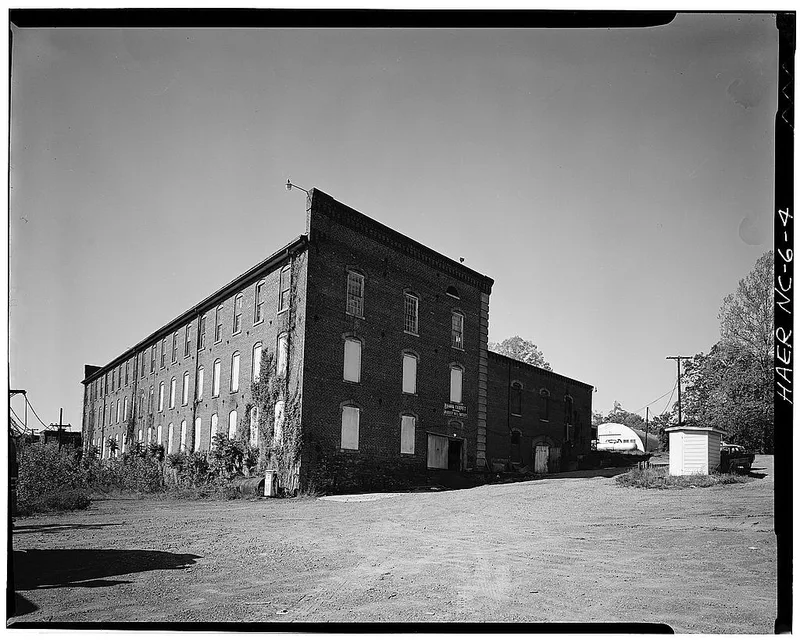
Glencoe is a cotton mill village on the east bank of the Haw River in Alamance County, North Carolina, covering a little over 100 acres. The mill was established by James H. and William E. Holt, sons of textile pioneer Edwin M. Holt, between 1880 and 1882, and it produced plaids, checks, flannels and napped cotton cloth. At its height it supported up to 500 people, about half of whom lived in mill housing on the site. The three-story brick mill, built in the Italianate style with stucco labels and a central tower, is the most important structure. Water power came from a concrete dam and a head race about 400 yards long feeding a turbine wheel house. The village retains dozens of frame worker houses along Front and Back Streets, a company store and office, and the mill superintendent's house. The complex is regarded as one of the best-preserved mill villages in the state, showing how textile work, housing and commerce were organized together.
Significance in brief: The nomination argues that Glencoe is a remarkably complete and well-preserved example of a late nineteenth-century water-powered Southern cotton mill village, showing the social, industrial and commercial functions combined in one community. It is also associated with the Holt family, influential in the textile industry of Alamance County and the Piedmont, and the mill building is an example of the Italianate brick mill type.
Machine-generated summary. This summary was generated by a language model from the official nomination document and has not been reviewed line by line by an editor. It may contain errors. Check the source document before relying on any detail. Source: nomination document (PDF) · National Archives catalog entry. NRHP reference 79001654, listed February 16, 1979. Summary generated October 2026 (model claude-haiku-5-5, prompt v1.1-2026-10-29, confidence high).
Key facts
| Address | Off NC 62 at Haw River, Glencoe |
|---|---|
| County | Alamance County |
| Listed | February 16, 1979 |
| Reference number | 79001654 |
| Resource type | District |
| Period of significance | 1800-1899 |
| Architectural style | Italianate |
| Criteria |
|
| Areas of significance | Community Planning and Development, Commerce, Architecture, Social History |
| Level of significance | State |
| Status (as stated in the nomination) | Mill buildings are in use today, with the 1950s addition housing a retail outlet; most other mill complex buildings are used for storage. Only seven dwellings were occupied at the time of the nomination, and much of the housing is deteriorating. |
| Acreage | 105 |
| Coordinates | 36.14083, -79.42938 (NPS GIS) |
What listing means for this property
This is a historic district. Buildings within its boundary are either contributing (they add to the district's significance) or non-contributing. Owners of contributing income-producing buildings can claim the 20% federal rehabilitation tax credit; homeowners should look at state credits. National Register districts impose no design review by themselves; a local historic district ordinance, if one exists, does (the difference explained).
General information, not legal or tax advice. Rules change; confirm with your State Historic Preservation Office or a qualified adviser.
Sources and further reading
- National Park Service, National Register of Historic Places database (snapshot May 2026), reference 79001654.
- Nomination form (PDF, National Archives) — catalog entry
- Wikipedia article (used for cross-checking only; text not reproduced here)
- Wikidata Q17560786
- This listing as JSON
Last updated October 2026. Found an error? See the editorial policy for how to report it.