Ingersoll, Robert, Birthplace

Why it's listed
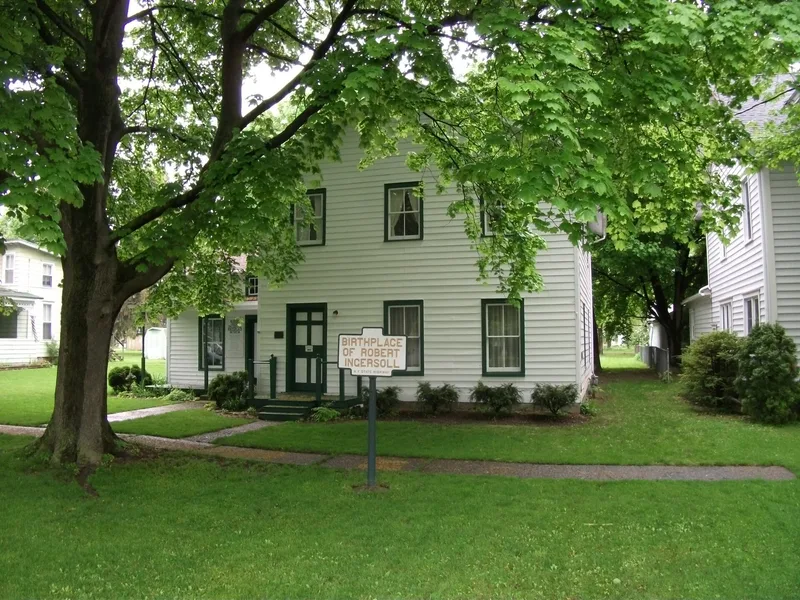
Robert Ingersoll's birthplace is a modest frame house on Main Street in Dresden, a quiet village on Seneca Lake in Yates County, New York. It consists of a two-story, three-bay main block with Federal style influence and a one-and-one-half-story saltbox ell. The two sections were built separately and joined, and were moved to the site, probably before Ingersoll was born there in 1833. Post-and-beam framing, clapboard siding, plank floors, plastered walls and simple woodwork survive. Ingersoll, who lived in the house only his first months, became one of the best-known nineteenth century American lecturers, famed for his "Plumed Knight" speech of 1876, his agnosticism and his support for civil rights. After his death, family members bought the house and dedicated it in 1921 as a community center. It later passed through several owners and fell vacant. The village of Dresden purchased it in 1985. It is believed to be the last surviving Ingersoll home.
Significance in brief: The nomination argues the house is an intact example of early nineteenth century vernacular residential architecture with Federal style influence. It is also the only known surviving resource associated with Robert Ingersoll, a popular and controversial American orator. Its interior room configurations and finishes are especially well preserved.
Machine-generated summary. This summary was generated by a language model from the official nomination document and has not been reviewed line by line by an editor. It may contain errors. Check the source document before relying on any detail. Source: nomination document (PDF) · National Archives catalog entry. NRHP reference 88000110, listed February 11, 1988. Summary generated October 2026 (model claude-sonnet-5-5, prompt v1.0-2026-10-29, confidence high).
Key facts
| Address | Main St., Dresden |
|---|---|
| County | Yates County |
| Listed | February 11, 1988 |
| Reference number | 88000110 |
| Resource type | Building |
| Period of significance | 1833 |
| Architect / builder | unknown |
| Architectural style | Vernacular Federal |
| Areas of significance | Politics/Government, Architecture |
| Level of significance | National |
| Status (as stated in the nomination) | Described as vacant and in fair condition, with some rotted floor joists and sill sections; owned by the Village of Dresden since 1985 after falling into disrepair. |
| Acreage | 0.9 |
| Coordinates | 42.68402, -76.95615 (NPS GIS) |
What listing means for this property
National Register listing is honorary: it recognises significance and does not restrict what a private owner may do without federal money or permits. It unlocks the 20% federal rehabilitation tax credit for income-producing buildings, state credits in many states, and Section 106 review when federal agencies are involved. See what listing means in practice.
Noted as vacant in the nomination. Nomination documents can be decades old; current status may differ. If you are considering buying an empty listed property, read the due-diligence checklist.
General information, not legal or tax advice. Rules change; confirm with your State Historic Preservation Office or a qualified adviser.
Sources and further reading
- National Park Service, National Register of Historic Places database (snapshot May 2026), reference 88000110.
- Nomination form (PDF, National Archives) — catalog entry
- Wikipedia article (used for cross-checking only; text not reproduced here)
- Wikidata Q7345790
- This listing as JSON
Last updated October 2026. Found an error? See the editorial policy for how to report it.