Yonkers Water Works

Why it's listed
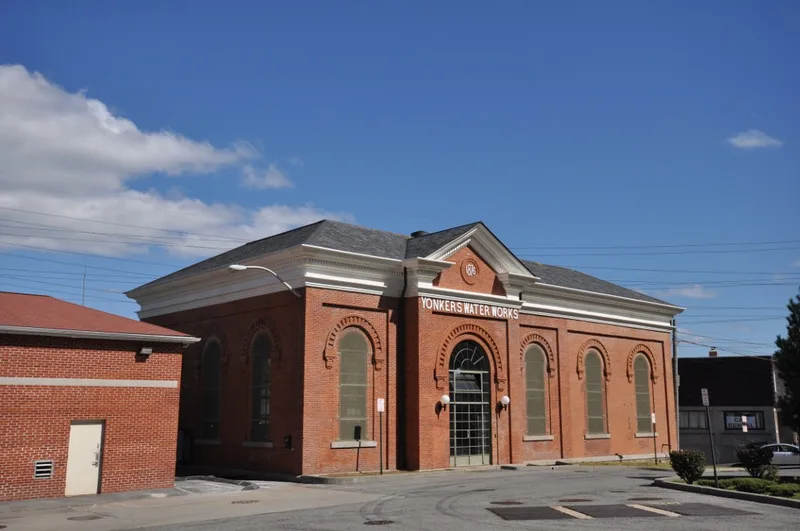
Three brick buildings preserve the early story of Yonkers' municipal water supply, the first public system in Westchester County. A disastrous fire in 1869 exposed the weakness of relying on rivers and cisterns, and voters and officials then moved toward a city system, begun in 1873. The Tuckahoe Road Pump Station, finished in 1876, has a hipped slate roof, round-arched windows and a brick medallion bearing its completion year. Its steam machinery has since been replaced by electric pumps and diesel engines. The Grassy Sprain Reservoir gate house, also from 1876, sits on a granite foundation near the dam and holds four control gates. It is no longer in use. The Tubewell Station, built in 1898 with a 1922 addition, was designed by architect A. F. Jennings of New York and used red brick with stone trim. Only the Tuckahoe Road station still pumps water, yet all three keep their High Victorian character and mark the city's nineteenth-century growth.
Significance in brief: The buildings are the surviving early structures of the first public water system in Westchester County. They are built in a High Victorian brick style and keep their nineteenth-century character. They are presented as symbols of the growth of Yonkers, the county's largest city, in the late 1800s.
Machine-generated summary. This summary was generated by a language model from the official nomination document and has not been reviewed line by line by an editor. It may contain errors. Check the source document before relying on any detail. Source: nomination document (PDF) · National Archives catalog entry. NRHP reference 82003419, listed July 21, 1982. Summary generated October 2026 (model claude-sonnet-5-5, prompt v1.0-2026-10-29, confidence medium).
Key facts
| Address | Roughly bounded by Saw Mill River and Grassy Sprain Rds., and Gilmare Dr., Yonkers |
|---|---|
| County | Westchester County |
| Listed | July 21, 1982 |
| Reference number | 82003419 |
| Resource type | Building |
| Period of significance | 1800-1899 |
| Architect / builder | Listed as Unknown on the form; the text names A. F. Jennings (architect) and R. L. Steward (builder) for the 1898 Tubewell pump house, and Cullen and Lawrence as contractors for the 1876 engine house. |
| Architectural style | High Victorian |
| Areas of significance | Community Planning and Development, Architecture |
| Level of significance | Local |
| Status (as stated in the nomination) | Only the Tuckahoe Road station still serves its original pumping function. The Grassy Sprain gate house is no longer in use. The Tubewell Station now holds city office space, storage and a truck repair garage, with its machinery kept as a back-up. |
| Acreage | 0.9 |
| Coordinates | 40.95674, -73.85788 (NPS GIS) |
What listing means for this property
For an income-producing building, listing (individually or as a contributing building in a district) is the gateway to the 20% federal rehabilitation tax credit on qualified rehabilitation costs, often stackable with state credits. Work claiming the credit must follow the Secretary of the Interior's Standards and be approved in advance.
Listing does not restrict a private owner acting without federal money or permits; where federal funding or licensing is involved, Section 106 review applies.
General information, not legal or tax advice. Rules change; confirm with your State Historic Preservation Office or a qualified adviser.
Sources and further reading
- National Park Service, National Register of Historic Places database (snapshot May 2026), reference 82003419.
- Nomination form (PDF, National Archives) — catalog entry
- Wikipedia article (used for cross-checking only; text not reproduced here)
- Wikidata Q8055096
- This listing as JSON
Last updated October 2026. Found an error? See the editorial policy for how to report it.