Old Fort House

Why it's listed
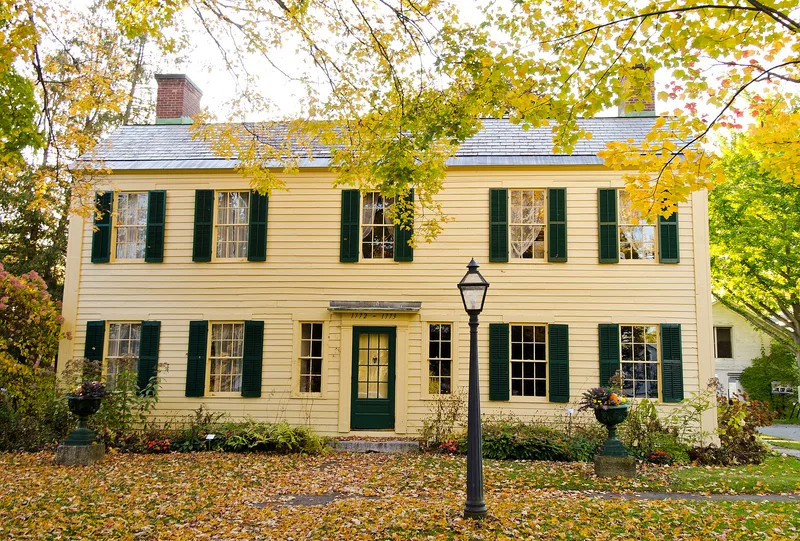
Begun in 1772 by Patrick Smyth, this two-story frame house on Lower Broadway in Fort Edward is the oldest surviving building in the village. Its heavy hewn timber frame was salvaged from the military fortifications of old Fort Edward, built 1755 to 1759. The house served as a tavern and as the Charlotte County courthouse from 1773 to 1775, and later as Washington County's courthouse until 1797. During the Saratoga campaign of 1777, British General Frasier and others used it as headquarters. In 1839 the Fort family remodeled it in a late Federal and Greek Revival manner, adding corner pilasters, six-over-six windows and a tiger maple stair rail. A 1943 fire damaged the roof, which was rebuilt in its gambrel form. Local business and professional men bought the property in 1949, and it opened as a museum that year. The site also holds a moved tollhouse, a moved law office and a c. 1910 concrete block barn used as a gallery.
Significance in brief: The nomination argues it is the oldest surviving building in the village of Fort Edward. It retains eighteenth and early nineteenth century design features, including a transitional Federal/Greek Revival remodeling of 1839. It also served as a tavern, community center, British military headquarters and county courthouse.
Machine-generated summary. This summary was generated by a language model from the official nomination document and has not been reviewed line by line by an editor. It may contain errors. Check the source document before relying on any detail. Source: nomination document (PDF) · National Archives catalog entry. NRHP reference 83001826, listed September 15, 1983. Summary generated October 2026 (model claude-sonnet-5-5, prompt v1.0-2026-10-29, confidence high).
Key facts
| Address | 29 Lower Broadway, Fort Edward |
|---|---|
| County | Washington County |
| Listed | September 15, 1983 |
| Reference number | 83001826 |
| Resource type | Building |
| Period of significance | 1772-1773 |
| Architect / builder | unknown (built for Patrick Smyth) |
| Architectural style | Transitional late Federal / early Greek Revival |
| Areas of significance | Exploration/Settlement, Architecture |
| Level of significance | Local |
| Status (as stated in the nomination) | Occupied and in excellent condition; owned by the Fort Edward Historical Association and operated as a local history museum. |
| Acreage | 4.5 |
| Coordinates | 43.26124, -73.58048 (NPS GIS) |
What listing means for this property
National Register listing is honorary for a privately owned home: it does not by itself restrict what an owner may do with their own money, and it does not require public access. Restrictions come from local landmark or historic-district ordinances, which are separate (how they differ).
Owner-occupied houses are not eligible for the 20% federal rehabilitation tax credit, which applies to income-producing buildings, but many states offer credits for homeowners. Listing also opens the door to preservation easements and to buying a plaque. Start with what listing means for homeowners, renovating a listed house and selling one.
General information, not legal or tax advice. Rules change; confirm with your State Historic Preservation Office or a qualified adviser.
Sources and further reading
- National Park Service, National Register of Historic Places database (snapshot May 2026), reference 83001826.
- Nomination form (PDF, National Archives) — catalog entry
- Wikipedia article (used for cross-checking only; text not reproduced here)
- Wikidata Q7084028
- This listing as JSON
Last updated October 2026. Found an error? See the editorial policy for how to report it.