Huguenot Street Historic District

Why it's listed
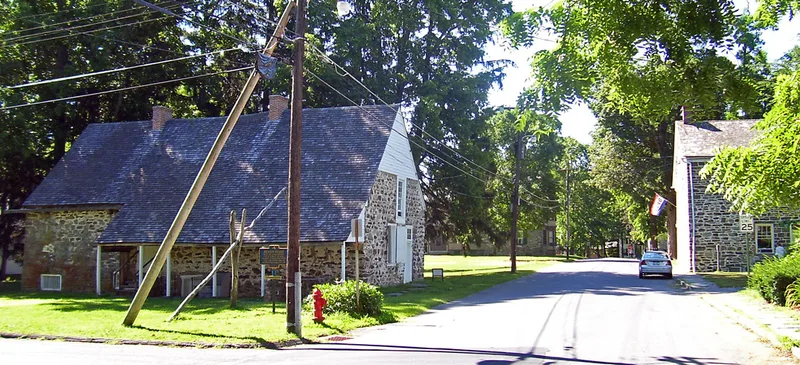
Huguenot Street in New Paltz, New York, preserves five stone houses built between about 1693 and 1775 by the families who founded the town. The settlers were French Protestants who fled to the Palatinate in Germany and then to America. In 1677 they bought their land from the Esopus Indians and established New Paltz on the Wallkill the following spring. The houses include the Jean Hasbrouck House of about 1712, the Abraham Hasbrouck House, the Hugo Freer House, the Bevier-Elting House and the Daniel DuBois House, which began as a one-story fort in 1705. Most are one-and-a-half story fieldstone buildings with steep gabled roofs, clapboarded gable ends and solid shutters, typical of Dutch Colonial work. The district is also valued for the settlers' self-government by twelve heads of families, known as the Dusine, which lasted until the town was incorporated in 1785. The street looks much as it did two centuries ago, and the houses remain in excellent condition.
Significance in brief: The street preserves the original settlement of French Huguenot families who bought the land from the Esopus Indians in 1677 and governed themselves through the Dusine, or Twelve Men, a system the form says has no parallel in colonial America. The five stone houses are also nationally significant as examples of Dutch Colonial architecture. The street looks much as it did over two hundred years ago and has no modern intrusions.
Machine-generated summary. This summary was generated by a language model from the official nomination document and has not been reviewed line by line by an editor. It may contain errors. Check the source document before relying on any detail. Source: nomination document (PDF) · National Archives catalog entry. NRHP reference 66000578, listed October 15, 1966. Summary generated October 2026 (model claude-sonnet-5-5, prompt v1.0-2026-10-29, confidence medium).
Key facts
| Address | Huguenot St., New Paltz |
|---|---|
| County | Ulster County |
| Listed | October 15, 1966 |
| Reference number | 66000578 |
| Resource type | District |
| Period of significance | 1677- |
| Architectural style | Dutch Colonial |
| Areas of significance | Exploration/Settlement, Architecture |
| Level of significance | National, Local |
| National Historic Landmark | Yes, designated October 9, 1960 |
| Status (as stated in the nomination) | The five stone houses are described as maintained in excellent condition, with no modern intrusions on the street. The Hugo Freer House was restored in 1963. |
| Acreage | 9.5 |
| Coordinates | 41.75187, -74.08807 (NPS GIS) |
What listing means for this property
This is a historic district. Buildings within its boundary are either contributing (they add to the district's significance) or non-contributing. Owners of contributing income-producing buildings can claim the 20% federal rehabilitation tax credit; homeowners should look at state credits. National Register districts impose no design review by themselves; a local historic district ordinance, if one exists, does (the difference explained).
General information, not legal or tax advice. Rules change; confirm with your State Historic Preservation Office or a qualified adviser.
Sources and further reading
- National Park Service, National Register of Historic Places database (snapshot May 2026), reference 66000578.
- Nomination form (PDF, National Archives) — catalog entry
- Wikipedia article (used for cross-checking only; text not reproduced here)
- Wikidata Q5934720
- This listing as JSON
Last updated October 2026. Found an error? See the editorial policy for how to report it.