State Theater

Why it's listed
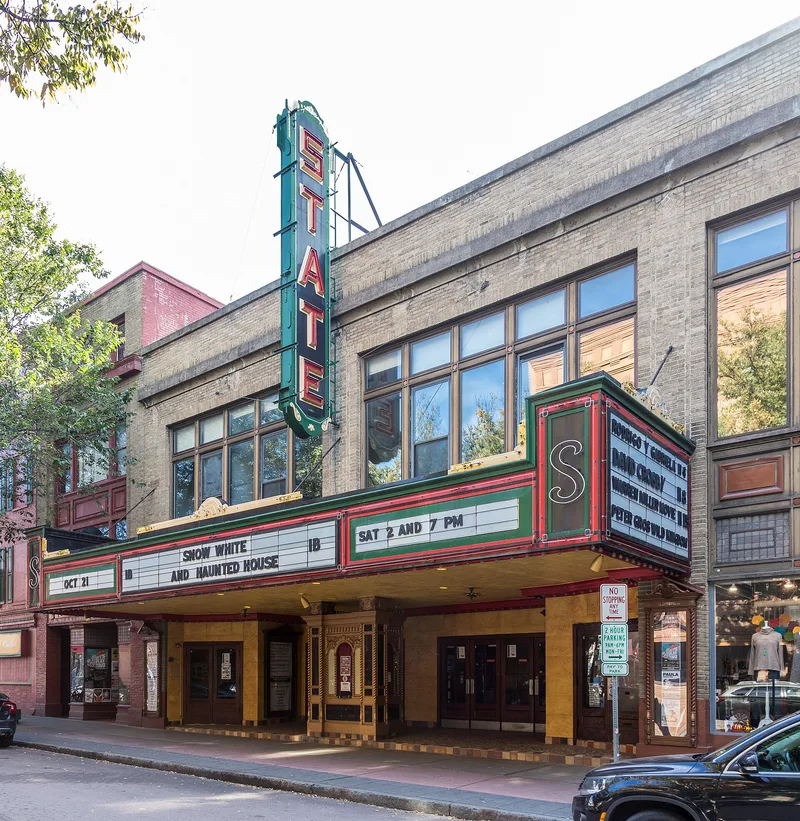
Located at 107-119 West State Street in downtown Ithaca, this brick building began in 1915 as a fireproof garage and automobile showroom designed by local architect Henry N. Hinckley. In 1928 the Berinstein family, operating as Cornell Theaters, Inc., hired architect Victor Rigaumont to convert it into a movie palace and road house. The plain buff-brick street front, with copper-framed windows, now carries a large illuminated marquee and a vertical neon sign. Inside, an atmospheric auditorium blends Collegiate Gothic, Moorish Revival and Renaissance Revival elements, including a crenelated parapet, turrets, gargoyles, Cornell and Oxford college shields, and a ceiling painted with constellations. The theater opened in December 1928 before an audience of 1,818. It is regarded as an example of the 1920s combination houses built for both vaudeville and film, and as Ithaca's finest surviving movie palace. The balcony has since become a second theater.
Significance in brief: The nomination presents the State Theater as Ithaca's finest movie palace, with an atmospheric interior blending Collegiate Gothic, Moorish Revival and Renaissance Revival elements. It typifies the opulent 1920s 'combination houses' that offered both live stage acts and motion pictures. Its large neon marquee and sign were noted as the first of their kind in Ithaca.
Machine-generated summary. This summary was generated by a language model from the official nomination document and has not been reviewed line by line by an editor. It may contain errors. Check the source document before relying on any detail. Source: nomination document (PDF) · National Archives catalog entry. NRHP reference 96000613, listed June 14, 1996. Summary generated October 2026 (model claude-sonnet-5-5, prompt v1.0-2026-10-29, confidence medium).
Key facts
| Address | 107--119 W. State St., Ithaca |
|---|---|
| County | Tompkins County |
| Listed | June 14, 1996 |
| Reference number | 96000613 |
| Resource type | Building |
| Architect / builder | Victor Rigaumont (1928 conversion); Henry N. Hinckley (original 1915 garage) |
| Architectural style | Early 20th Century; Collegiate Gothic (with Moorish Revival and Renaissance Revival elements) |
| Areas of significance | Entertainment/Recreation, Architecture |
| Level of significance | Local |
| Status (as stated in the nomination) | Still used as a theater; the balcony has been converted into a second theater, and the offices of a performing arts organization occupy part of the building. |
| Within district | Ithaca Downtown Historic District (Additional Documentation) |
| Coordinates | 42.43932, -76.49956 (NPS GIS) |
What listing means for this property
For an income-producing building, listing (individually or as a contributing building in a district) is the gateway to the 20% federal rehabilitation tax credit on qualified rehabilitation costs, often stackable with state credits. Work claiming the credit must follow the Secretary of the Interior's Standards and be approved in advance.
Listing does not restrict a private owner acting without federal money or permits; where federal funding or licensing is involved, Section 106 review applies.
General information, not legal or tax advice. Rules change; confirm with your State Historic Preservation Office or a qualified adviser.
Sources and further reading
- National Park Service, National Register of Historic Places database (snapshot May 2026), reference 96000613.
- Nomination form (PDF, National Archives) — catalog entry
- Wikipedia article (used for cross-checking only; text not reproduced here)
- Wikidata Q7603563
- This listing as JSON
Last updated October 2026. Found an error? See the editorial policy for how to report it.