Clinton House
Also known as: Clinton Hotel

Why it's listed
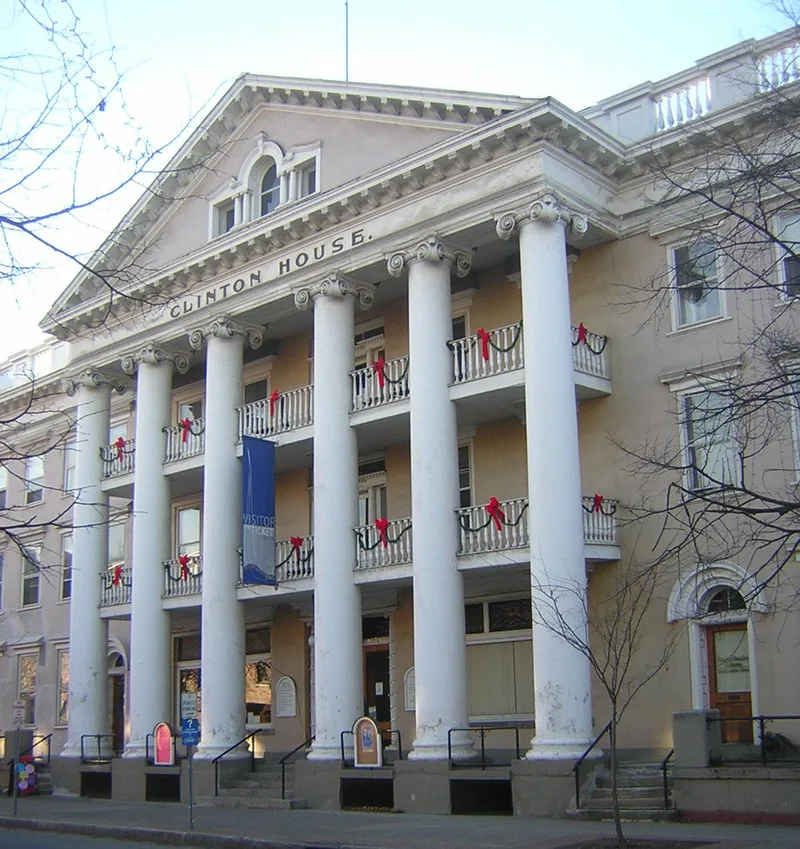
Clinton House is a large hotel at 116 North Cayuga Street in Ithaca, begun in 1828 and completed in 1830 when the village had fewer than 4,000 residents. Three local businessmen, Jeremiah S. Beebe, Henry Ackley and Henry Hibbard, joined to build it during a period of strong economic growth. Ira Tillotson was probably the architect and builder. The building mixes Federal and Greek Revival styles and has a six-column Ionic portico, a grand staircase and a central cupola. It originally held about 150 rooms. In 1872 William Henry Miller added a mansard roof and a new cupola, and the lobby and stairway keep features from a 1901 Colonial Revival remodeling. The hotel has operated as an inn for 140 years. Surveyor-General Simeon DeWitt lived and died there, at least four Presidents stayed as guests, and students, businesspeople and townspeople used its rooms for meals and celebrations. Nineteenth-century writers praised it as the most imposing building in Ithaca.
Significance in brief: The nomination calls it Ithaca's finest landmark building and a splendid example of Federal-Greek Revival transition architecture. It was one of the earliest luxury hotels in America and has served as an inn, social center and lodging for notable guests for about 140 years. It also carries later work by architects such as William Henry Miller.
Machine-generated summary. This summary was generated by a language model from the official nomination document and has not been reviewed line by line by an editor. It may contain errors. Check the source document before relying on any detail. Source: nomination document (PDF) · National Archives catalog entry. NRHP reference 71000560, listed August 12, 1971. Summary generated October 2026 (model claude-sonnet-5-5, prompt v1.0-2026-10-29, confidence high).
Key facts
| Address | 116 N. Cayuga St., Ithaca |
|---|---|
| County | Tompkins County |
| Listed | August 12, 1971 |
| Reference number | 71000560 |
| Resource type | Building |
| Period of significance | 19th Century (built 1828-1830) |
| Architect / builder | Probably Ira Tillotson (architect and builder); 1872 additions designed by William Henry Miller |
| Architectural style | Federal-Greek Revival transition |
| Areas of significance | Commerce, Architecture, Social History |
| Level of significance | State |
| Status (as stated in the nomination) | Described as continuously in business as an inn for 140 years, with small businesses in the basement; condition marked fair and altered, and a later grant supported exterior restoration. |
| Acreage | 0.5 |
| Within district | Ithaca Downtown Historic District (Additional Documentation) |
| Coordinates | 42.44013, -76.49935 (NPS GIS) |
What listing means for this property
National Register listing is honorary for a privately owned home: it does not by itself restrict what an owner may do with their own money, and it does not require public access. Restrictions come from local landmark or historic-district ordinances, which are separate (how they differ).
Owner-occupied houses are not eligible for the 20% federal rehabilitation tax credit, which applies to income-producing buildings, but many states offer credits for homeowners. Listing also opens the door to preservation easements and to buying a plaque. Start with what listing means for homeowners, renovating a listed house and selling one.
General information, not legal or tax advice. Rules change; confirm with your State Historic Preservation Office or a qualified adviser.
Sources and further reading
- National Park Service, National Register of Historic Places database (snapshot May 2026), reference 71000560.
- Nomination form (PDF, National Archives) — catalog entry
- Wikipedia article (used for cross-checking only; text not reproduced here)
- Wikidata Q1101691
- This listing as JSON
Last updated October 2026. Found an error? See the editorial policy for how to report it.