Longwood Historic District

Why it's listed
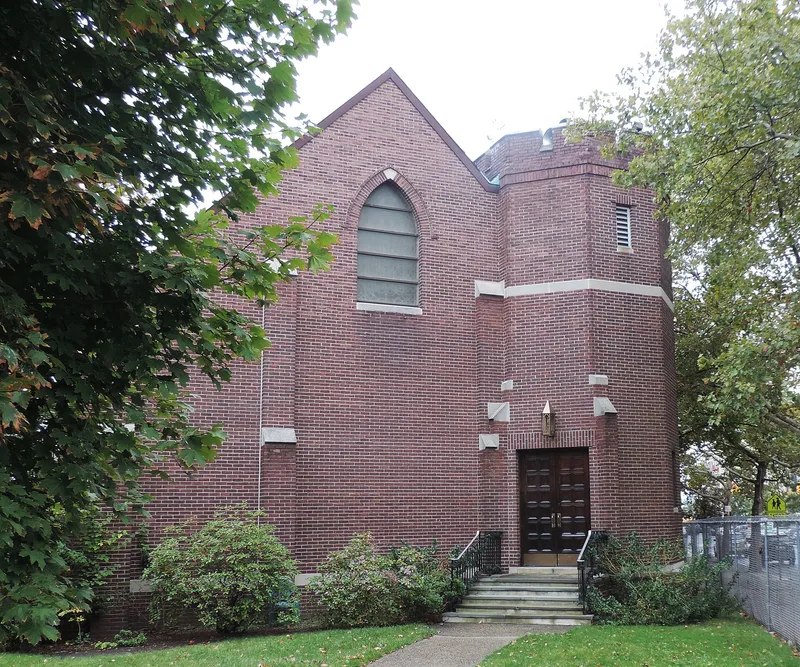
Longwood Historic District is a residential neighborhood in the South Bronx, built mainly between 1898 and 1906 on the site of a former estate. Developer George B. Johnson bought the abandoned S. B. White estate around 1898 and hired architect Warren C. Dickerson to design nearly all of the buildings. Rows of 2½-story semi-detached brick houses line Hewitt Place, Dawson, Kelly and Beck Streets, Macy Place and East 156th Street. The houses are set back behind gardens and iron-railed stoops, and many have false mansard roofs with polygonal or conical peaks. Their style blends neo-Renaissance details, such as masonry bays and classical columns, with the heavier proportions, rough-cut stone and arched windows of the Romanesque Revival. Other buildings include a former synagogue, an Episcopal church, a small apartment building and a hospital. The district contrasts with surrounding blocks of tenements and frame houses, and it was listed for its consistent architecture and planned development.
Significance in brief: The district is an unusual, cohesive turn-of-the-century neighborhood, developed by George B. Johnson on a former estate and designed almost entirely by architect Warren C. Dickerson. Its houses combine neo-Renaissance and Romanesque Revival elements and are strikingly homogeneous. It contains some of the best of the turn-of-the-century architecture that turned the Bronx into an urban extension of Manhattan.
Machine-generated summary. This summary was generated by a language model from the official nomination document and has not been reviewed line by line by an editor. It may contain errors. Check the source document before relying on any detail. Source: nomination document (PDF) · National Archives catalog entry. NRHP reference 83001640, listed September 26, 1983. Summary generated October 2026 (model claude-sonnet-5-5, prompt v1.0-2026-10-29, confidence high).
Key facts
| Address | Roughly bounded by Beck St., Longwood, Leggett, and Prospect Aves., New York |
|---|---|
| County | The Bronx |
| Listed | September 26, 1983 |
| Reference number | 83001640 |
| Resource type | District |
| Period of significance | 1898-1906 |
| Architect / builder | Warren C. Dickerson, Charles S. Clark, James Meeham et. al. |
| Architectural style | Neo-Renaissance combined with Romanesque Revival |
| Areas of significance | Architecture |
| Level of significance | Local |
| Status (as stated in the nomination) | Most buildings are in excellent to good condition. A 2010 rehabilitation returned the former estate house at 990 East 156th Street to its 1900 appearance as the Longwood Club, making it a contributing building. The Cedars housing project (2010) is non-contributing. |
| Acreage | 16 |
| Coordinates | 40.81549, -73.89905 (NPS GIS) |
What listing means for this property
This is a historic district. Buildings within its boundary are either contributing (they add to the district's significance) or non-contributing. Owners of contributing income-producing buildings can claim the 20% federal rehabilitation tax credit; homeowners should look at state credits. National Register districts impose no design review by themselves; a local historic district ordinance, if one exists, does (the difference explained).
General information, not legal or tax advice. Rules change; confirm with your State Historic Preservation Office or a qualified adviser.
Sources and further reading
- National Park Service, National Register of Historic Places database (snapshot May 2026), reference 83001640.
- Nomination form (PDF, National Archives) — catalog entry
- Wikipedia article (used for cross-checking only; text not reproduced here)
- Wikidata Q6674522
- This listing as JSON
Last updated October 2026. Found an error? See the editorial policy for how to report it.