Rialto Theatre
Also known as: Miller and Washington Block

Why it's listed
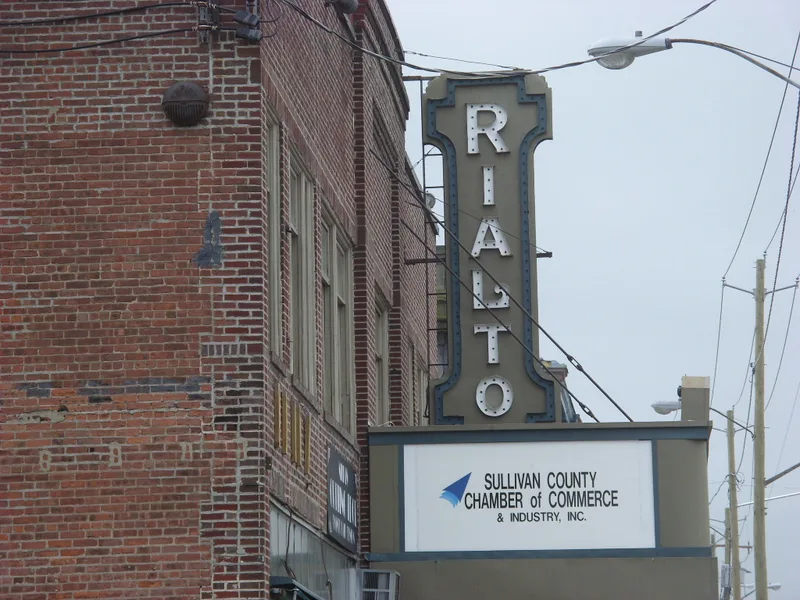
Built in 1921 on Broadway in Monticello, the Rialto Theatre formed part of the Miller and Washington Block, a commercial venture by two local businessmen. The block combined three ground-floor stores, a theater with a 136-foot auditorium, and a second-floor restaurant that seated more than four hundred. Local architect Emil Motel is credited with the design, which uses brick of varying hues for banding, a corbeled cornice and a stepped parapet. The theater rose soon after a 1909 fire destroyed much of the village center, and it helped spur downtown rebuilding. Movies drew overflow crowds, and the theater became a focus of social life; its success contributed to the closing of the larger Lyceum in 1922. Although the foyer has been enclosed as a store and a dropped ceiling hides the original plaster, the stage, spatial layout, neon sign and painted wall murals survive. A non-profit arts group was acquiring the building for restoration and reuse.
Significance in brief: The nomination argues the Rialto is a distinctive, largely intact twentieth-century theater in Sullivan County and part of the recreation and entertainment culture of the western Catskills resort era. It was the most important of Monticello's three early theaters and a catalyst for downtown rebuilding after the 1909 fire. It retains its exterior design, functional divisions and some interior decoration, including wall murals.
Machine-generated summary. This summary was generated by a language model from the official nomination document and has not been reviewed line by line by an editor. It may contain errors. Check the source document before relying on any detail. Source: nomination document (PDF) · National Archives catalog entry. NRHP reference 01000043, listed February 2, 2001. Summary generated October 2026 (model claude-sonnet-5-5, prompt v1.0-2026-10-29, confidence medium).
Key facts
| Address | Broadway, Monticello |
|---|---|
| County | Sullivan County |
| Listed | February 2, 2001 |
| Reference number | 01000043 |
| Resource type | Building |
| Period of significance | 1921 |
| Architect / builder | Emil Motel, architect |
| Architectural style | Late 19th and early 20th century revivals |
| Criteria |
|
| Areas of significance | Entertainment/Recreation, Architecture |
| Level of significance | Local |
| Status (as stated in the nomination) | Vacant; the auditorium has not been used as a theater for eighteen years and was most recently a mattress warehouse. Purchase by a non-profit arts group and restoration for arts use were being planned. |
| Acreage | 0.9 |
| Within district | Broadway Historic District |
| Coordinates | 41.65556, -74.68770 (NPS GIS) |
What listing means for this property
For an income-producing building, listing (individually or as a contributing building in a district) is the gateway to the 20% federal rehabilitation tax credit on qualified rehabilitation costs, often stackable with state credits. Work claiming the credit must follow the Secretary of the Interior's Standards and be approved in advance.
Listing does not restrict a private owner acting without federal money or permits; where federal funding or licensing is involved, Section 106 review applies.
Noted as vacant in the nomination. Nomination documents can be decades old; current status may differ. If you are considering buying an empty listed property, read the due-diligence checklist.
General information, not legal or tax advice. Rules change; confirm with your State Historic Preservation Office or a qualified adviser.
Sources and further reading
- National Park Service, National Register of Historic Places database (snapshot May 2026), reference 01000043.
- Nomination form (PDF, National Archives) — catalog entry
- Wikipedia article (used for cross-checking only; text not reproduced here)
- Wikidata Q7322147
- This listing as JSON
Last updated October 2026. Found an error? See the editorial policy for how to report it.