St. Johns Episcopal Church and Cemetery

Why it's listed
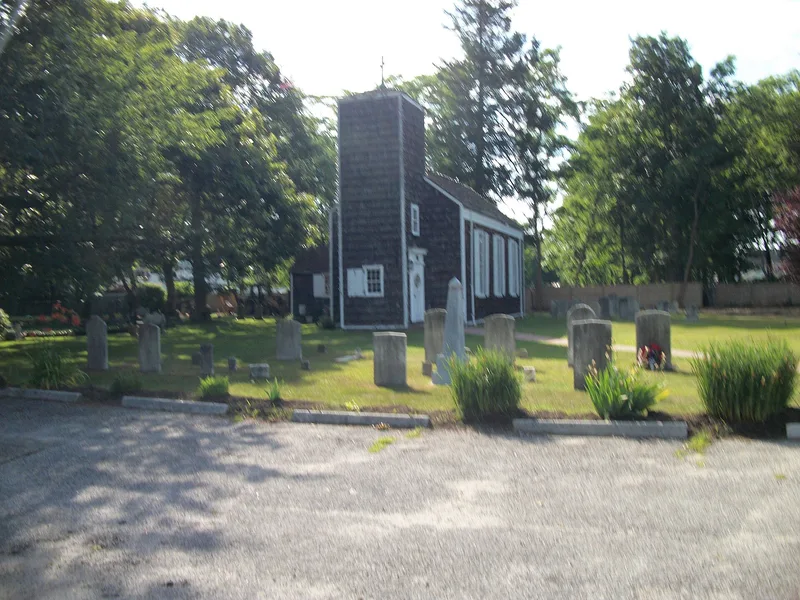
Set well back from Montauk Highway in Oakdale, this small one-story church with a gable roof, wood shingle siding and an engaged three-story tower dates to 1765. It began as a private chapel for the Nicoll family, who held a large manor nearby, and also served enslaved people, free Indians and neighbors. Originally called the Charlotte Church, it took its present name after the Revolution. Around 1843 it was enlarged from two bays to three and given Greek Revival trim, and a stained-glass chancel window was added in 1873. Regular services lapsed after about 1875, the church reopened as a summer wayside chapel in 1928, and a restoration followed in 1962. Its heavy timber frame and wide shingle sheathing reflect Long Island's English-derived building tradition. The surrounding cemetery holds about 100 burials, the last in 1916. Together they mark the early settlement of Islip and are among the town's most significant local landmarks.
Significance in brief: The church is argued to be a rare surviving example of mid-eighteenth century ecclesiastical architecture in Suffolk County and a distinguished example of vernacular Colonial architecture. It keeps its heavy timber frame, rectangular form, central tower, wide wood shingles and minimal ornamentation. Its cemetery of about 100 graves and its links to the Nicoll family recall the early development of Islip.
Machine-generated summary. This summary was generated by a language model from the official nomination document and has not been reviewed line by line by an editor. It may contain errors. Check the source document before relying on any detail. Source: nomination document (PDF) · National Archives catalog entry. NRHP reference 93001559, listed January 28, 1994. Summary generated October 2026 (model claude-sonnet-5-5, prompt v1.0-2026-10-29, confidence high).
Key facts
| Address | Montauk Hwy. NE side, about 300' NW of the jct. with Locust Ave., Town of Islip, Oakdale |
|---|---|
| County | Suffolk County |
| Listed | January 28, 1994 |
| Reference number | 93001559 |
| Resource type | Building |
| Period of significance | 1765 - 1916 |
| Architectural style | Colonial/Postmedieval English; Mid-19th Century/Greek Revival |
| Criteria |
|
| Areas of significance | Architecture |
| Level of significance | Local |
| Status (as stated in the nomination) | Still used as a religious facility and cemetery; restored in 1962, with a modern sacristy added at that time. |
| Acreage | 0.9 |
| Coordinates | 40.73543, -73.11684 (NPS GIS) |
What listing means for this property
Religious properties are listed for their architectural or historical significance, not their religious use. Listing is honorary and does not restrict the congregation's use of the building. The federal rehabilitation credit is generally unavailable unless part of the building is income-producing; some state programmes and preservation grants do cover religious buildings. Federal funding or permits trigger Section 106 review.
General information, not legal or tax advice. Rules change; confirm with your State Historic Preservation Office or a qualified adviser.
Sources and further reading
- National Park Service, National Register of Historic Places database (snapshot May 2026), reference 93001559.
- Nomination form (PDF, National Archives) — catalog entry
- Wikipedia article (used for cross-checking only; text not reproduced here)
- Wikidata Q7589010
- This listing as JSON
Last updated October 2026. Found an error? See the editorial policy for how to report it.