Homan-Gerard House and Mills

Why it's listed
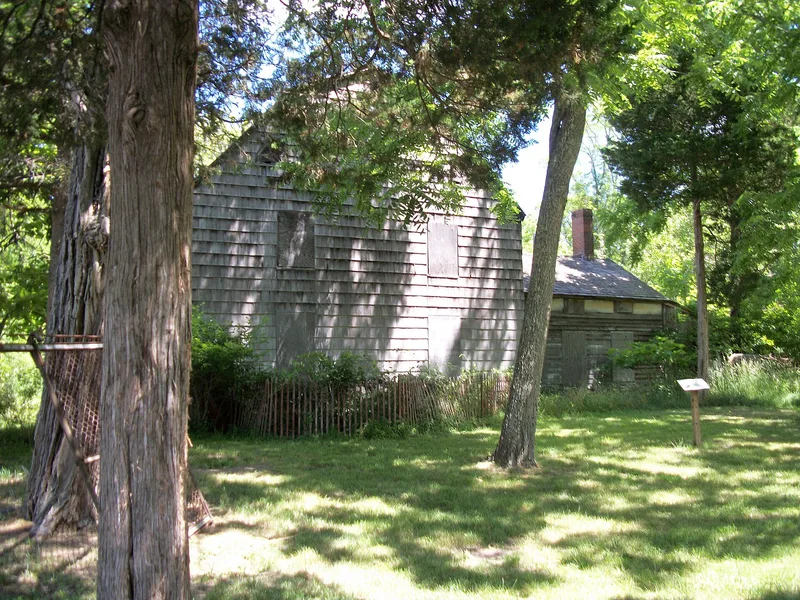
This six-acre site in Yaphank, Suffolk County, combines a circa 1790 house with the remains of the mills that supported it. The two-and-one-half-story frame house has a gambrel roof, a three-bay facade, a center chimney and original riven wood shingles. A kitchen wing was added around 1825-1840. Federal details include a sidelighted doorway with reeded pilasters, quarter-circle fan windows and round-arched traceried attic windows. Behind the house stand a barn and three sheds, and nearby are a kitchen midden, a family cemetery and the site of a store and post office. John Homan was granted the right to build a sawmill in 1762 and a gristmill in 1771, and his descendants and the Gerard family operated the mills until they burned in the early twentieth century. The property was recognized as a rare surviving example of a family-run milling complex. The house is now vacant and deteriorating, but its rural setting is preserved within a county park.
Significance in brief: The complex is argued to be the significant property of a locally important family milling operation in central Suffolk County, run by John Homan and his descendants from 1762 to about 1900. The house is a highly intact example of a gambrel-roofed Federal style residence typical of eighteenth-century Long Island. The mill and midden sites have yielded, and may yield, information on how the mills worked and how people lived.
Machine-generated summary. This summary was generated by a language model from the official nomination document and has not been reviewed line by line by an editor. It may contain errors. Check the source document before relying on any detail. Source: nomination document (PDF) · National Archives catalog entry. NRHP reference 88002761, listed December 16, 1988. Summary generated October 2026 (model claude-sonnet-5-5, prompt v1.0-2026-10-29, confidence medium).
Key facts
| Address | Jct. Main St. and Yaphank Rd., Yaphank |
|---|---|
| County | Suffolk County |
| Listed | December 16, 1988 |
| Reference number | 88002761 |
| Resource type | Building |
| Period of significance | 1762-1899 |
| Architect / builder | Unknown |
| Architectural style | Early Republic/Federal |
| Criteria |
|
| Areas of significance | Community Planning and Development, Commerce, Historic - Non-Aboriginal, Architecture |
| Level of significance | Local |
| Status (as stated in the nomination) | The house has not been occupied for decades and has deteriorated badly. Floors have broken through, plaster is crumbling, and many doors and windows are boarded up. It lies within a Suffolk County park. |
| Acreage | 6 |
| Coordinates | 40.83616, -72.91561 (NPS GIS) |
What listing means for this property
National Register listing is honorary for a privately owned home: it does not by itself restrict what an owner may do with their own money, and it does not require public access. Restrictions come from local landmark or historic-district ordinances, which are separate (how they differ).
Owner-occupied houses are not eligible for the 20% federal rehabilitation tax credit, which applies to income-producing buildings, but many states offer credits for homeowners. Listing also opens the door to preservation easements and to buying a plaque. Start with what listing means for homeowners, renovating a listed house and selling one.
Noted as vacant in the nomination. Nomination documents can be decades old; current status may differ. If you are considering buying an empty listed property, read the due-diligence checklist.
General information, not legal or tax advice. Rules change; confirm with your State Historic Preservation Office or a qualified adviser.
Sources and further reading
- National Park Service, National Register of Historic Places database (snapshot May 2026), reference 88002761.
- Nomination form (PDF, National Archives) — catalog entry
- Wikipedia article (used for cross-checking only; text not reproduced here)
- Wikidata Q5887746
- This listing as JSON
Last updated October 2026. Found an error? See the editorial policy for how to report it.