Hayground Windmill

Why it's listed
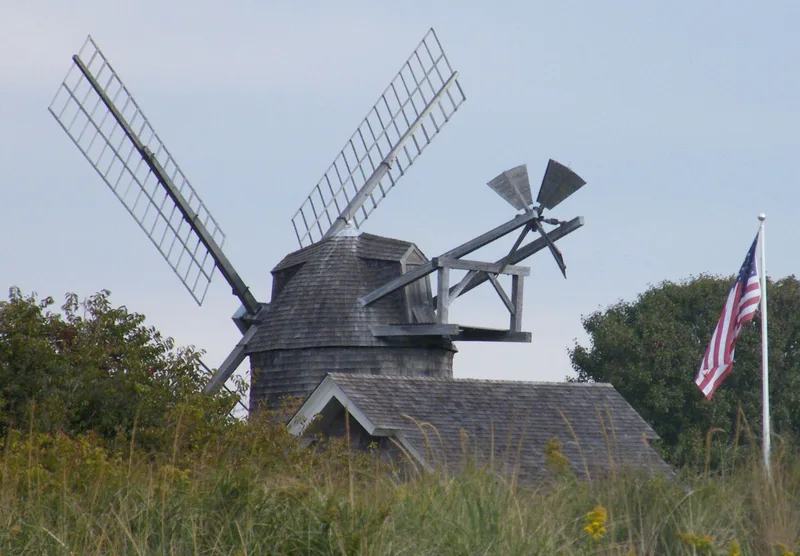
Built in 1801, this three-story smock windmill on Windmill Lane in East Hampton is 36 feet tall, clad in shingles, and topped by a conical cap turned by a fantail. It was the last windmill operated commercially on Long Island, grinding grain until 1919. The structure has an interlocking wood frame and keeps most of its internal machinery, including a windshaft, brake wheel, wallower, great spur wheel, and two pairs of French burr millstones. A screener and elevator also remain. The mill never worked at its present site. It was moved in 1950, when it received a concrete foundation, new floor sheathing, and replacement of several sides. The windshaft had been replaced in 1933. It stands on a raised plot within a private estate and is listed as vacant. Its significance lies in showing the sophisticated wooden technology of eastern Long Island's windmills, and it is considered one of the best surviving examples among them.
Significance in brief: It was the last windmill operated commercially on Long Island (1919) and keeps much of its internal machinery. Although it never operated at its present location, it illustrates the sophisticated wooden technology of eastern Long Island's windmills.
Machine-generated summary. This summary was generated by a language model from the official nomination document and has not been reviewed line by line by an editor. It may contain errors. Check the source document before relying on any detail. Source: nomination document (PDF) · National Archives catalog entry. NRHP reference 78001913, listed December 27, 1978. Summary generated October 2026 (model claude-sonnet-5-5, prompt v1.0-2026-10-29, confidence medium).
Key facts
| Address | At Windmill Lane, East Hampton |
|---|---|
| County | Suffolk County |
| Listed | December 27, 1978 |
| Reference number | 78001913 |
| Resource type | Building |
| Architectural style | Smock mill (three-story, shingle clad, conical cap with fantail) |
| Areas of significance | Industry, Engineering, Architecture |
| Level of significance | State |
| Status (as stated in the nomination) | Listed as vacant, in fair condition. The mill survives in operable condition with its major internal workings intact. It was moved in 1950 onto a concrete foundation and sits on a private estate. |
| Coordinates | 40.95493, -72.16525 (NPS GIS) |
What listing means for this property
National Register listing is honorary: it recognises significance and does not restrict what a private owner may do without federal money or permits. It unlocks the 20% federal rehabilitation tax credit for income-producing buildings, state credits in many states, and Section 106 review when federal agencies are involved. See what listing means in practice.
Noted as vacant in the nomination. Nomination documents can be decades old; current status may differ. If you are considering buying an empty listed property, read the due-diligence checklist.
General information, not legal or tax advice. Rules change; confirm with your State Historic Preservation Office or a qualified adviser.
Sources and further reading
- National Park Service, National Register of Historic Places database (snapshot May 2026), reference 78001913.
- Nomination form (PDF, National Archives) — catalog entry
- Wikipedia article (used for cross-checking only; text not reproduced here)
- Wikidata Q14706335
- This listing as JSON
Last updated October 2026. Found an error? See the editorial policy for how to report it.