Field, Marshall, III, Estate
Also known as: Caumsett State Park

Why it's listed
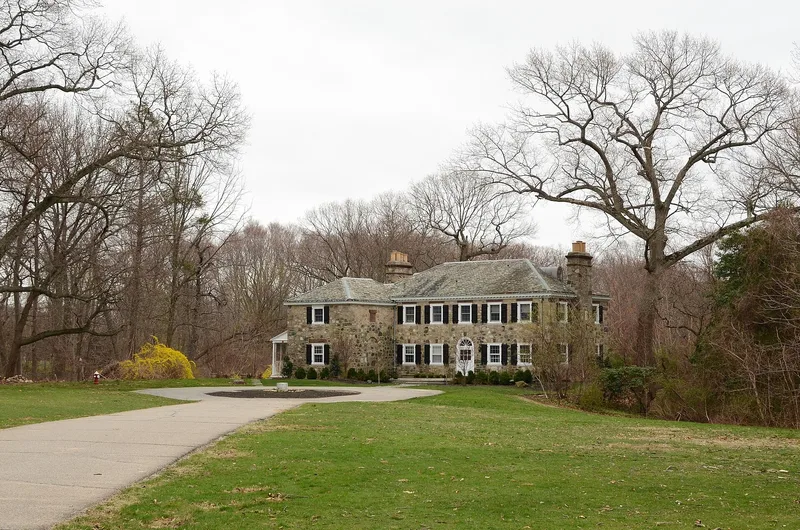
Caumsett State Park occupies about 1,400 acres on Lloyd Neck, between Long Island Sound and Lloyd Harbor. It began as the country seat of Marshall Field III, who bought roughly two thousand acres in 1921 and hired architect John Russell Pope to plan a self-sustaining estate. Completed in 1925, the property includes a rose-brick Georgian Revival main house, a garage for twenty automobiles, a polo stable, cottages, greenhouses, and a large farm complex for prize Guernsey cattle. The estate had its own electric and water systems, still operating, and a staff of eighty-five. Pope also incorporated the Henry Lloyd House, built in 1711, as a gate lodge. That house is the oldest surviving on Lloyd Neck, and Jupiter Hammon, regarded as America's first black poet, was born on the manor. Archeological work found evidence of prehistoric occupation. New York State bought the estate in 1961 and operates it as a park.
Significance in brief: The nomination argues the estate is architecturally, historically and culturally significant as the best-preserved of Long Island's early twentieth-century country estates, with a Georgian Revival mansion and many dependencies by John Russell Pope. It also preserves the 1711 Henry Lloyd House, evidence of prehistoric occupation, the birthplace of poet Jupiter Hammon, and a varied natural landscape.
Machine-generated summary. This summary was generated by a language model from the official nomination document and has not been reviewed line by line by an editor. It may contain errors. Check the source document before relying on any detail. Source: nomination document (PDF) · National Archives catalog entry. NRHP reference 79001633, listed April 30, 1979. Summary generated October 2026 (model claude-sonnet-5-5, prompt v1.0-2026-10-29, confidence medium).
Key facts
| Address | Lloyd Harbor Rd., Lloyd Harbor |
|---|---|
| County | Suffolk County |
| Listed | April 30, 1979 |
| Reference number | 79001633 |
| Resource type | Building |
| Period of significance | 1923-25 |
| Architect / builder | John Russell Pope |
| Architectural style | Georgian Revival |
| Areas of significance | Agriculture, Architecture |
| Level of significance | State |
| Status (as stated in the nomination) | Now a state park owned by the State of New York. Many buildings are in use by park staff, an outdoor education center and a historical society; the Winter Cottage is no longer in use. The two west wings of the main house were removed in 1950. |
| Acreage | 1400 |
| Coordinates | 40.93079, -73.46699 (NPS GIS) |
What listing means for this property
National Register listing is honorary for a privately owned home: it does not by itself restrict what an owner may do with their own money, and it does not require public access. Restrictions come from local landmark or historic-district ordinances, which are separate (how they differ).
Owner-occupied houses are not eligible for the 20% federal rehabilitation tax credit, which applies to income-producing buildings, but many states offer credits for homeowners. Listing also opens the door to preservation easements and to buying a plaque. Start with what listing means for homeowners, renovating a listed house and selling one.
General information, not legal or tax advice. Rules change; confirm with your State Historic Preservation Office or a qualified adviser.
Sources and further reading
- National Park Service, National Register of Historic Places database (snapshot May 2026), reference 79001633.
- Nomination form (PDF, National Archives) — catalog entry
- Wikipedia article (used for cross-checking only; text not reproduced here)
- Wikidata Q5054543
- This listing as JSON
Last updated October 2026. Found an error? See the editorial policy for how to report it.