Woodrow Methodist Church

Why it's listed
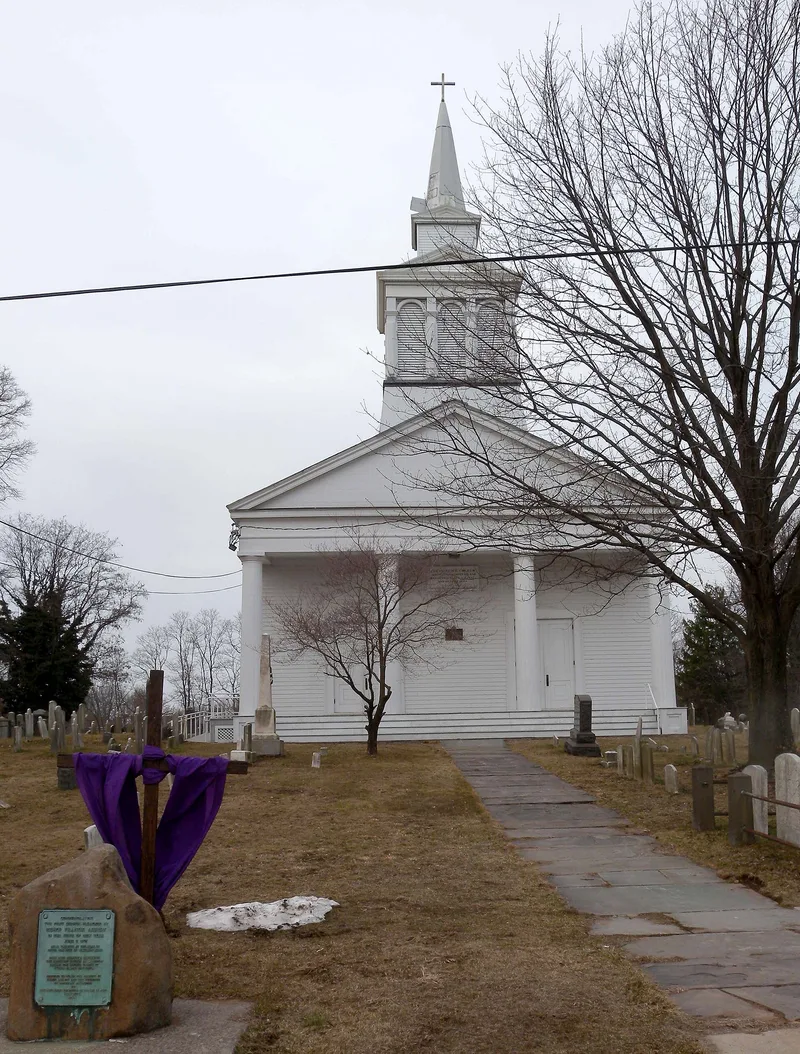
Set on a sloping, tree-shaded two-and-one-third-acre site on Staten Island, this wooden church and its surrounding graveyard preserve a sense of the area's rural past. The temple-form building, completed in 1842 and dedicated on Christmas Day, has clapboard walls, a shingled roof and a portico of four baseless Greek Doric columns. An open three-stage bell tower and spire in a vernacular Italianate style was added in 1876, housing a bell given by a grandson of the first preacher. The congregation is the oldest Methodist group on the island, tracing its roots to visits by the itinerant preacher Francis Asbury in 1771 and the first local society of 1787. Henry Boehm, an influential minister, is buried in the churchyard. A parsonage dating from 1850 stands to the south. The plain design reflects Methodist ideals of simple, modest worship buildings.
Significance in brief: It houses the oldest Methodist congregation on Staten Island, known as the "mother church of Methodism on Staten Island," tracing to Francis Asbury's preaching visits beginning in 1771. Its plain, dignified Greek Revival form reflects Methodism's populist, rural origins and Wesley's call for plain preaching houses. The 1876 tower marks the movement's shift toward a more ecclesiastical appearance.
Machine-generated summary. This summary was generated by a language model from the official nomination document and has not been reviewed line by line by an editor. It may contain errors. Check the source document before relying on any detail. Source: nomination document (PDF) · National Archives catalog entry. NRHP reference 82001265, listed October 29, 1982. Summary generated October 2026 (model claude-sonnet-5-5, prompt v1.0-2026-10-29, confidence high).
Key facts
| Address | 1109 Woodrow Rd., New York |
|---|---|
| County | Staten Island |
| Listed | October 29, 1982 |
| Reference number | 82001265 |
| Resource type | Building |
| Period of significance | 1842/1876 |
| Architectural style | Greek Revival, with a vernacular Italianate bell tower |
| Areas of significance | Architecture, Religion |
| Level of significance | Local |
| Status (as stated in the nomination) | Occupied and in use as a religious building; condition listed as good and altered. The tower was enclosed in aluminum siding in 1982 but remains intact beneath it. |
| Acreage | 2.3 |
| Coordinates | 40.54308, -74.20131 (NPS GIS) |
What listing means for this property
Religious properties are listed for their architectural or historical significance, not their religious use. Listing is honorary and does not restrict the congregation's use of the building. The federal rehabilitation credit is generally unavailable unless part of the building is income-producing; some state programmes and preservation grants do cover religious buildings. Federal funding or permits trigger Section 106 review.
General information, not legal or tax advice. Rules change; confirm with your State Historic Preservation Office or a qualified adviser.
Sources and further reading
- National Park Service, National Register of Historic Places database (snapshot May 2026), reference 82001265.
- Nomination form (PDF, National Archives) — catalog entry
- Wikipedia article (used for cross-checking only; text not reproduced here)
- Wikidata Q8033177
- This listing as JSON
Last updated October 2026. Found an error? See the editorial policy for how to report it.