Elliott, Dr. Samuel MacKenzie, House

Why it's listed
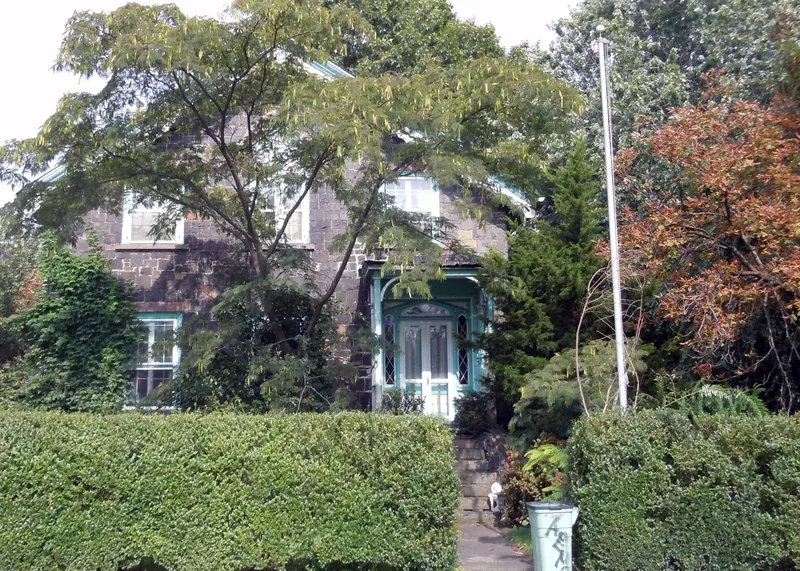
This small Gothic cottage at 69 Delafield Place, in the Livingston area of northern Staten Island, is built of dark grey, locally quarried stone with wooden trim and scalloped bargeboards on its gables. It has two main stories, an attic and a large cellar, and keeps original details such as marble mantels, wide plank floors and an ornate entry with tinted sidelights. Dr. Samuel MacKenzie Elliott, a Scottish-born physician described as the first American doctor to specialize in eye care, built it. Between 1839 and 1856 he bought lots near New Brighton, named the area Elliottville, and built more than twenty houses there, helping to spur local development. The cottage reflects the romantic, rustic principles of Andrew Jackson Downing's Cottage Residences. Reviewers noted its significance as an example of the Gothic cottage type. A tradition holds that the cellar fireplace was used by escaping slaves on the Underground Railroad. It remains a private home amid later houses.
Significance in brief: The house is presented as a fine, simple example of the picturesque rural Gothic cottages popular in the United States in the mid-1800s, in keeping with Andrew Jackson Downing's ideas. It was built by Dr. Elliott, a prominent eye specialist who developed the surrounding Elliottville neighborhood and was active in the anti-slavery movement.
Machine-generated summary. This summary was generated by a language model from the official nomination document and has not been reviewed line by line by an editor. It may contain errors. Check the source document before relying on any detail. Source: nomination document (PDF) · National Archives catalog entry. NRHP reference 80002757, listed March 28, 1980. Summary generated October 2026 (model claude-sonnet-5-5, prompt v1.0-2026-10-29, confidence high).
Key facts
| Address | 69 Delafield Pl., New York |
|---|---|
| County | Staten Island |
| Listed | March 28, 1980 |
| Reference number | 80002757 |
| Resource type | Building |
| Period of significance | Mid 19th Century |
| Architect / builder | Dr. Samuel MacKenzie Elliott |
| Architectural style | Gothic cottage (picturesque rural Gothic) |
| Criteria |
|
| Areas of significance | Other, Health/Medicine, Exploration/Settlement, Architecture |
| Level of significance | Local |
| Status (as stated in the nomination) | Continues to function as a comfortable residence; occupied private residence, altered but retaining many original interior details. |
| Acreage | 0.9 |
| Coordinates | 40.64403, -74.10975 (NPS GIS) |
What listing means for this property
National Register listing is honorary for a privately owned home: it does not by itself restrict what an owner may do with their own money, and it does not require public access. Restrictions come from local landmark or historic-district ordinances, which are separate (how they differ).
Owner-occupied houses are not eligible for the 20% federal rehabilitation tax credit, which applies to income-producing buildings, but many states offer credits for homeowners. Listing also opens the door to preservation easements and to buying a plaque. Start with what listing means for homeowners, renovating a listed house and selling one.
General information, not legal or tax advice. Rules change; confirm with your State Historic Preservation Office or a qualified adviser.
Sources and further reading
- National Park Service, National Register of Historic Places database (snapshot May 2026), reference 80002757.
- Nomination form (PDF, National Archives) — catalog entry
- Wikipedia article (used for cross-checking only; text not reproduced here)
- Wikidata Q5304370
- This listing as JSON
Last updated October 2026. Found an error? See the editorial policy for how to report it.