Kinne, David and Mary, Farmstead

Why it's listed
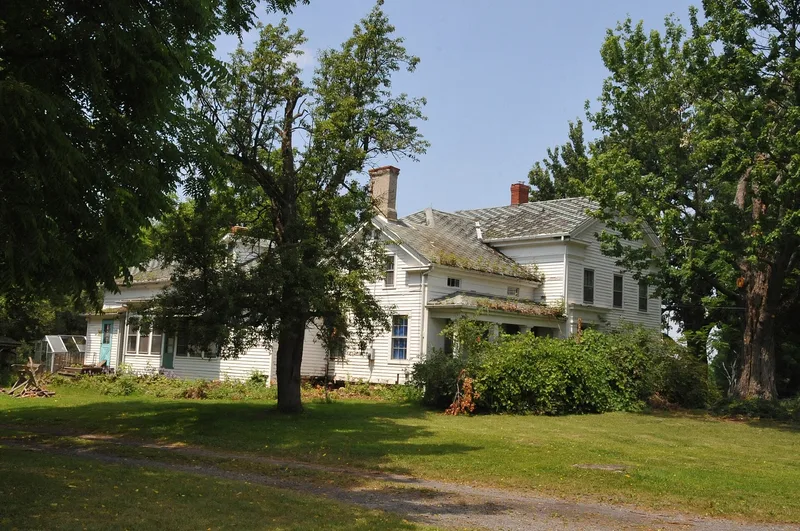
This 104-acre farmstead northwest of Ovid, in the town of Romulus, Seneca County, centers on a vernacular Greek Revival house built about 1855 by David Wisner Kinne and Mary Stone Kinne. Seven intact outbuildings survive: an outhouse, machine shop, carriage house, horse barn, scale house, gambrel-roofed barn and machine shed. The farm focused on grain rather than dairy, and the scale house was used to weigh grain from surrounding farms. In 1850 Kinne was among the county's largest oat producers, and his farm ranked among its most valuable. He was also an abolitionist who gave money to the New York State Vigilance Committee in 1849, subscribed to Frederick Douglass' Paper and ran for the Assembly on the Liberty Party ticket. Family tradition connects the farm to the Underground Railroad, but no documents confirm it. The property is notable for agriculture, social history, architecture and its largely unchanged nineteenth-century setting.
Significance in brief: The farm is tied to David and Mary Kinne, grain farmers and abolitionists, and illustrates the importance of grain production in Seneca County. David Kinne's anti-slavery activity is documented, and a family tradition links the farm to the Underground Railroad, though no documents support it. The house and outbuildings are also intact examples of Greek Revival architecture and 19th-century farm construction.
Machine-generated summary. This summary was generated by a language model from the official nomination document and has not been reviewed line by line by an editor. It may contain errors. Check the source document before relying on any detail. Source: nomination document (PDF) · National Archives catalog entry. NRHP reference 07000865, listed August 30, 2007. Summary generated October 2026 (model claude-sonnet-5-5, prompt v1.0-2026-10-29, confidence high).
Key facts
| Address | 6858 Kinne Rd., Ovid |
|---|---|
| County | Seneca County |
| Listed | August 30, 2007 |
| Reference number | 07000865 |
| Resource type | Building |
| Period of significance | ca. 1840 - ca. 1900 |
| Architectural style | Early 19th Century: Greek Revival |
| Criteria |
|
| Areas of significance | Black, Social History, Agriculture, Architecture |
| Level of significance | Local |
| Status (as stated in the nomination) | Historic and current function is single family dwelling; the farm stayed in the Kinne family until very recently and retains exceptional integrity. |
| Acreage | 104.1 |
| Coordinates | 42.69190, -76.84419 (NPS GIS) |
What listing means for this property
National Register listing is honorary for a privately owned home: it does not by itself restrict what an owner may do with their own money, and it does not require public access. Restrictions come from local landmark or historic-district ordinances, which are separate (how they differ).
Owner-occupied houses are not eligible for the 20% federal rehabilitation tax credit, which applies to income-producing buildings, but many states offer credits for homeowners. Listing also opens the door to preservation easements and to buying a plaque. Start with what listing means for homeowners, renovating a listed house and selling one.
General information, not legal or tax advice. Rules change; confirm with your State Historic Preservation Office or a qualified adviser.
Sources and further reading
- National Park Service, National Register of Historic Places database (snapshot May 2026), reference 07000865.
- Nomination form (PDF, National Archives) — catalog entry
- Wikipedia article (used for cross-checking only; text not reproduced here)
- Wikidata Q5241438
- This listing as JSON
Last updated October 2026. Found an error? See the editorial policy for how to report it.