Watkins Glen Commercial Historic District

Why it's listed
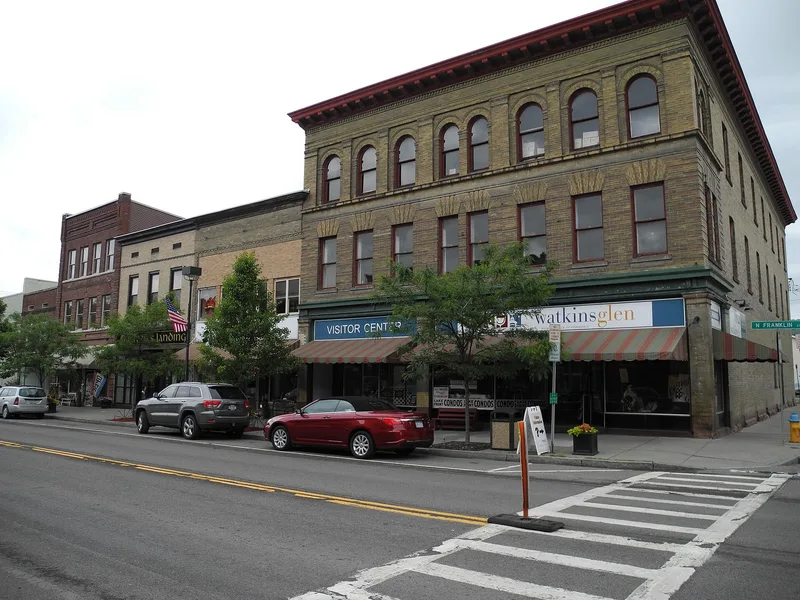
Three blocks of North Franklin Street in Watkins Glen, at the southern tip of Seneca Lake, make up this downtown district of 33 contributing buildings built between 1844 and 1939. Most are two- and three-story masonry commercial buildings with similar scale, setbacks, rooflines and materials. Styles include Italianate, Classical Revival, Colonial Revival, Second Empire and Richardsonian Romanesque. Key buildings are the 1939 WPA-funded Municipal Building, Hotel Kendall, the former post office in a Second Empire corner building, the stone Freer Opera House and the Durand Block. A 1924 fire destroyed seven buildings on Franklin and 4th Streets, and several storefronts were rebuilt afterward. The district represents the commercial heart of a village that grew through canals and railroads, then industry, salt-based health resorts and tourism. Watkins Glen has been the county seat since 1868. Later demolitions reduced a once six-block business area to the surviving three-block core.
Significance in brief: The district is significant under Criterion A for commerce as the core business district during the village's growth as a transportation, industrial and tourism hub. It is significant under Criterion C for its intact collection of downtown buildings in a variety of styles popular during the village's periods of greatest growth.
Machine-generated summary. This summary was generated by a language model from the official nomination document and has not been reviewed line by line by an editor. It may contain errors. Check the source document before relying on any detail. Source: nomination document (PDF) · National Archives catalog entry. NRHP reference 11001009, listed January 4, 2012. Summary generated October 2026 (model claude-sonnet-5-5, prompt v1.0-2026-10-29, confidence medium).
Key facts
| Address | 108-400 & 201-317 N. Franklin St., 111 W. 4th St. & 215 S. Madison St., Watkins Glen |
|---|---|
| County | Schuyler County |
| Listed | January 4, 2012 |
| Reference number | 11001009 |
| Resource type | District |
| Period of significance | 1844-1939 |
| Architect / builder | Raymond Freeburg (1939 Village Hall); J. C. Considine & P. H. Downes (Hotel Kendall); James Drake & William Newman (Freer Opera House) |
| Architectural style | Commercial: Greek Revival, Italianate, Classical Revival, Colonial Revival, Second Empire, Romanesque |
| Criteria |
|
| Areas of significance | Architecture, Commerce |
| Level of significance | Local |
| Status (as stated in the nomination) | Buildings are generally in good to excellent condition, with several recently renovated; some upper floors are vacant and there are a few gaps in the streetscape. |
| Acreage | 4.5 |
| Coordinates | 42.38343, -76.87358 (NPS GIS) |
What listing means for this property
This is a historic district. Buildings within its boundary are either contributing (they add to the district's significance) or non-contributing. Owners of contributing income-producing buildings can claim the 20% federal rehabilitation tax credit; homeowners should look at state credits. National Register districts impose no design review by themselves; a local historic district ordinance, if one exists, does (the difference explained).
General information, not legal or tax advice. Rules change; confirm with your State Historic Preservation Office or a qualified adviser.
Sources and further reading
- National Park Service, National Register of Historic Places database (snapshot May 2026), reference 11001009.
- Nomination form (PDF, National Archives) — catalog entry
- Wikipedia article (used for cross-checking only; text not reproduced here)
- Wikidata Q23092149
- This listing as JSON
Last updated October 2026. Found an error? See the editorial policy for how to report it.