St. James Episcopal Church

Why it's listed
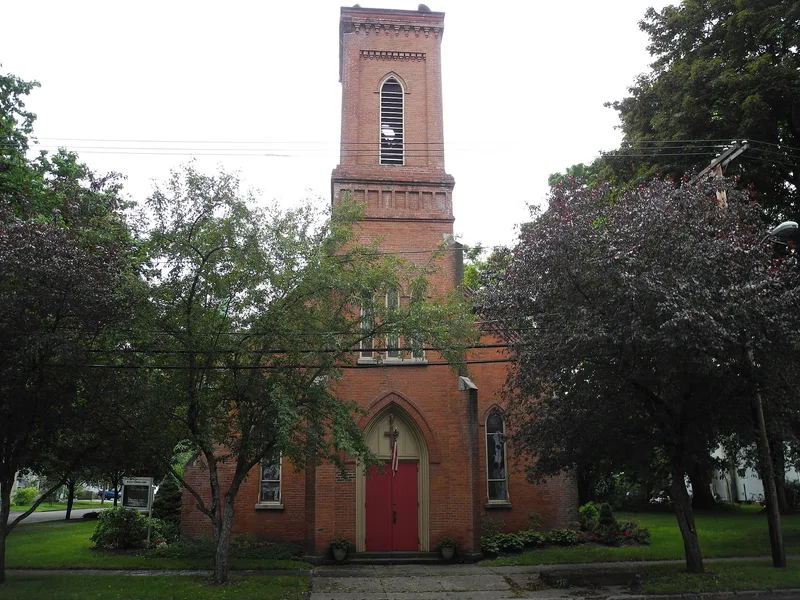
St. James Episcopal Church is a brick Gothic Revival church at the corner of Sixth Street and Decatur Avenue in Watkins Glen, at the south end of Seneca Lake. Construction began in 1863, and the first service was held on Christmas Day 1864. A square bell tower with the main entrance was added in 1866, and a chancel and vestry rooms followed in 1878. The building keeps a high-pitched roof, pointed arched windows, corner buttresses and small metal spires. Steel roof trusses were added in the 1920s to address problems from soft soils. The parish, founded in 1830, moved away from the lakeshore to a newer residential area near Lafayette Park. It was the first brick church in the village and the first to adopt the Gothic Revival style, which the neighboring Presbyterian and Baptist congregations later copied. The builder or architect is unknown. The church is valued as an intact example of mid-nineteenth century Episcopal church design.
Significance in brief: The nomination argues the church is a highly intact mid-nineteenth century Gothic Revival building, significant for its architecture. It was the first church to relocate to the residential area around Lafayette Park and the first to use the Gothic Revival style, which the Presbyterians and Baptists later followed. It also reflects the village's nineteenth-century growth.
Machine-generated summary. This summary was generated by a language model from the official nomination document and has not been reviewed line by line by an editor. It may contain errors. Check the source document before relying on any detail. Source: nomination document (PDF) · National Archives catalog entry. NRHP reference 12000960, listed November 21, 2012. Summary generated October 2026 (model claude-sonnet-5-5, prompt v1.0-2026-10-29, confidence high).
Key facts
| Address | 112 6th St., Watkins Glen |
|---|---|
| County | Schuyler County |
| Listed | November 21, 2012 |
| Reference number | 12000960 |
| Resource type | Building |
| Period of significance | 1864-1878 |
| Architect / builder | unknown |
| Architectural style | Gothic Revival |
| Criteria |
|
| Areas of significance | Architecture |
| Level of significance | Local |
| Status (as stated in the nomination) | Still an active church. The attached parish house, remodeled around 1970, is non-contributing because of lost integrity. |
| Acreage | 0.9 |
| Coordinates | 42.38207, -76.87095 (NPS GIS) |
What listing means for this property
Religious properties are listed for their architectural or historical significance, not their religious use. Listing is honorary and does not restrict the congregation's use of the building. The federal rehabilitation credit is generally unavailable unless part of the building is income-producing; some state programmes and preservation grants do cover religious buildings. Federal funding or permits trigger Section 106 review.
General information, not legal or tax advice. Rules change; confirm with your State Historic Preservation Office or a qualified adviser.
Sources and further reading
- National Park Service, National Register of Historic Places database (snapshot May 2026), reference 12000960.
- Nomination form (PDF, National Archives) — catalog entry
- Wikipedia article (used for cross-checking only; text not reproduced here)
- Wikidata Q23092092
- This listing as JSON
Last updated October 2026. Found an error? See the editorial policy for how to report it.