First Methodist Episcopal Church of Nyack
Also known as: Old Stone Church

Why it's listed
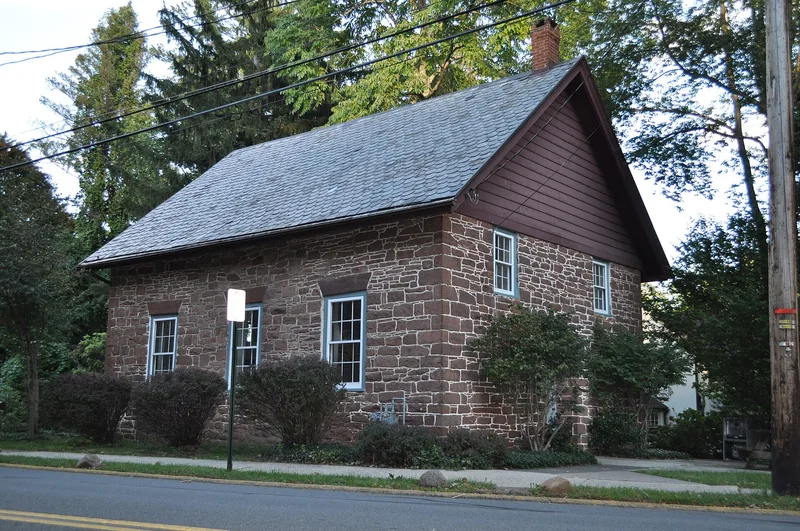
Built of local sandstone on a small lot beside North Broadway in Upper Nyack, the Old Stone Church was raised by a Methodist Episcopal congregation formed after a Dutch Reformed petition for a Nyack church was rejected in 1812. Land and quarry stone were donated by William Palmer, and the trustees resolved to begin building the next morning. The church was dedicated in March 1814. It is a plain three-by-two-bay building with a slate gable roof, six-over-six windows with splayed stone lintels, and timber-framed clapboard gables. Inside is an open auditorium with a raised platform and a south gallery. The roof was altered around 1870, when the eaves were extended and slate installed. The building is recognized as a regional example of a Federal era meeting house, valued for its restrained design and stonework. It remains in religious use and keeps a high degree of its original character.
Significance in brief: The nomination argues the church is architecturally significant as a regional example of early nineteenth-century Federal era church architecture and meeting house form. It is noted for its rigorous simplicity and fine sandstone construction, and it retains a high degree of integrity despite limited changes.
Machine-generated summary. This summary was generated by a language model from the official nomination document and has not been reviewed line by line by an editor. It may contain errors. Check the source document before relying on any detail. Source: nomination document (PDF) · National Archives catalog entry. NRHP reference 98000132, listed February 20, 1998. Summary generated October 2026 (model claude-sonnet-5-5, prompt v1.0-2026-10-29, confidence high).
Key facts
| Address | North Broadway, S of jct. of North Broadway and Birchwood Ave., Upper Nyack |
|---|---|
| County | Rockland County |
| Listed | February 20, 1998 |
| Reference number | 98000132 |
| Resource type | Building |
| Period of significance | 1812 |
| Architectural style | Early Republic / Federal |
| Criteria |
|
| Areas of significance | Architecture |
| Level of significance | Local |
| Status (as stated in the nomination) | Still used as a religious facility; a small lavatory addition was made in the late twentieth century and the interior floor was replaced in the 1970s. |
| Acreage | 0.9 |
| Coordinates | 41.10356, -73.91736 (NPS GIS) |
What listing means for this property
Religious properties are listed for their architectural or historical significance, not their religious use. Listing is honorary and does not restrict the congregation's use of the building. The federal rehabilitation credit is generally unavailable unless part of the building is income-producing; some state programmes and preservation grants do cover religious buildings. Federal funding or permits trigger Section 106 review.
General information, not legal or tax advice. Rules change; confirm with your State Historic Preservation Office or a qualified adviser.
Sources and further reading
- National Park Service, National Register of Historic Places database (snapshot May 2026), reference 98000132.
- Nomination form (PDF, National Archives) — catalog entry
- Wikipedia article (used for cross-checking only; text not reproduced here)
- Wikidata Q5453321
- This listing as JSON
Last updated October 2026. Found an error? See the editorial policy for how to report it.