Patroon Agent's House and Office
Also known as: Whish-Hull House and Rector

Why it's listed
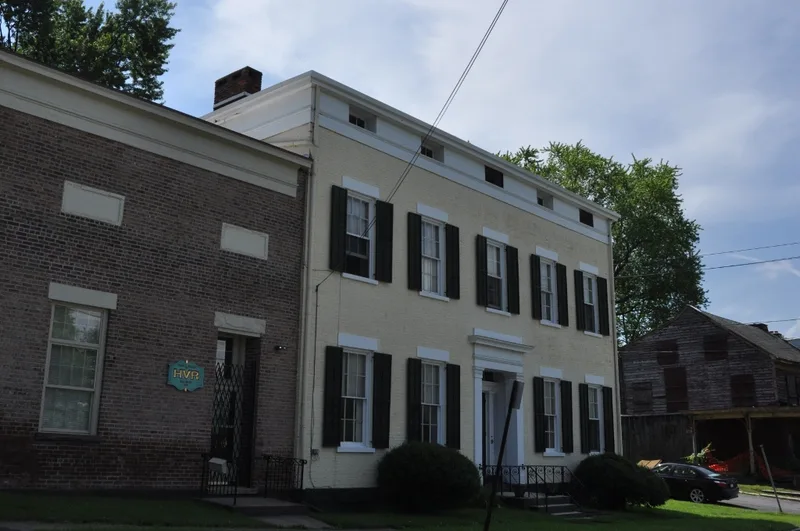
Built in 1839 near the Hudson River in the north end of Rensselaer, this brick house and attached office served Casparus Pruyn, rent collection agent for William Van Rensselaer, whose family held the manor of Rensselaerswyck. The office wing contains two heavily secured vaults for rent returns and valuable papers, with iron bars and heavy iron doors meant to foil thieves and anti-renters. Pruyn worked in the middle of the Anti-Rent Wars between 1839 and 1844, when tenant farmers resisted back rents. The house is a typical northeastern Greek Revival design with a five-bay front, sandstone lintels, built-in folding shutters, marble mantels and a mahogany stair rail rising to the attic from a rare rosewood-veneer newel post. The office has a corbeled-arched ceiling and an unusual sloping roof on a truss. The residence and office were first sold separately in 1904, and the house has changed little since.
Significance in brief: The nomination ties the property to the Anti-Rent Wars, the Van Rensselaer family and the history of the city of Rensselaer. It also argues for architectural significance as a well-preserved Greek Revival building with an unusual attached office containing secured vaults, an arched ceiling and a rare Empire style newel post.
Machine-generated summary. This summary was generated by a language model from the official nomination document and has not been reviewed line by line by an editor. It may contain errors. Check the source document before relying on any detail. Source: nomination document (PDF) · National Archives catalog entry. NRHP reference 79001622, listed August 3, 1979. Summary generated October 2026 (model claude-sonnet-5-5, prompt v1.0-2026-10-29, confidence high).
Key facts
| Address | 15 Forbes Ave., Rensselaer |
|---|---|
| County | Rensselaer County |
| Listed | August 3, 1979 |
| Reference number | 79001622 |
| Resource type | Building |
| Period of significance | 1800-1899 |
| Architectural style | Greek Revival |
| Areas of significance | Politics/Government, Architecture |
| Level of significance | State |
| Status (as stated in the nomination) | Condition is listed as good and altered. The house continues as a residence, and the office is used for storage. The two parts are in separate ownership. |
| Acreage | 0.9 |
| Coordinates | 42.65729, -73.73497 (NPS GIS) |
What listing means for this property
National Register listing is honorary for a privately owned home: it does not by itself restrict what an owner may do with their own money, and it does not require public access. Restrictions come from local landmark or historic-district ordinances, which are separate (how they differ).
Owner-occupied houses are not eligible for the 20% federal rehabilitation tax credit, which applies to income-producing buildings, but many states offer credits for homeowners. Listing also opens the door to preservation easements and to buying a plaque. Start with what listing means for homeowners, renovating a listed house and selling one.
General information, not legal or tax advice. Rules change; confirm with your State Historic Preservation Office or a qualified adviser.
Sources and further reading
- National Park Service, National Register of Historic Places database (snapshot May 2026), reference 79001622.
- Nomination form (PDF, National Archives) — catalog entry
- Wikipedia article (used for cross-checking only; text not reproduced here)
- Wikidata Q7148153
- This listing as JSON
Last updated October 2026. Found an error? See the editorial policy for how to report it.