Clark-Dearstyne-Miller Inn

Why it's listed
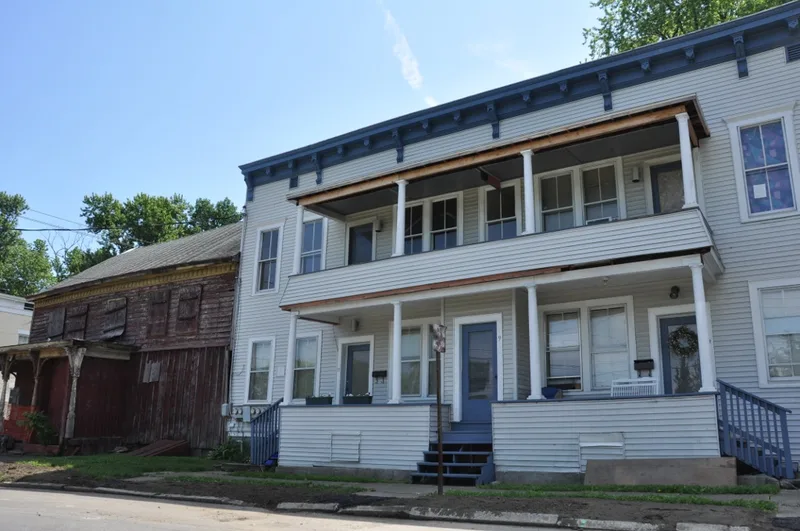
Standing at the corner of Forbes and Central Avenues in Rensselaer, this former tavern and hotel was built soon after 1791 on land granted to Jeremiah Clark by Stephen Van Rensselaer. The 2 1/2-story, five-bay building has a heavy hand-hewn timber frame, narrow clapboard siding, a denticulated Federal cornice, and a bracketed porch added around 1880. Inside, a large second-floor room once served as a ballroom and public meeting space. The inn sat near the Hudson River ferry slip and the railroad station, serving ferry passengers, rail travelers and tenant farmers who came to pay rents to the Van Rensselaer agent. James Dearstyne owned it from 1839 to 1867, and it later operated as the Miller Hotel into the 1920s. Local tradition holds that President Lincoln's body rested there in 1865. It is valued as a rare Federal-period commercial building and a link to Bath-on-Hudson's early history. The building is now vacant and deteriorated, though its timber frame remains largely intact.
Significance in brief: The nomination argues the building is a rare surviving example of vernacular Federal-period commercial architecture in the present city of Rensselaer, and one of only two Federal-period buildings left in the community. It served travelers as a tavern and hostelry into the early twentieth century and reflects the importance of Bath-on-Hudson as a transportation hub.
Machine-generated summary. This summary was generated by a language model from the official nomination document and has not been reviewed line by line by an editor. It may contain errors. Check the source document before relying on any detail. Source: nomination document (PDF) · National Archives catalog entry. NRHP reference 07001369, listed January 9, 2008. Summary generated October 2026 (model claude-sonnet-5-5, prompt v1.0-2026-10-29, confidence high).
Key facts
| Address | 11-13 Forbes Ave., Rensselaer |
|---|---|
| County | Rensselaer County |
| Listed | January 9, 2008 |
| Reference number | 07001369 |
| Resource type | Building |
| Period of significance | 1791-circa 1880 |
| Architectural style | Early Republic / Federal |
| Criteria |
|
| Areas of significance | Commerce, Architecture |
| Level of significance | Local |
| Status (as stated in the nomination) | The building is vacant; it was operated as a neighborhood tavern from the 1950s until its abandonment in the 1980s, and its interior is deteriorated. |
| Acreage | 0.9 |
| Coordinates | 42.65887, -73.73447 (NPS GIS) |
What listing means for this property
For an income-producing building, listing (individually or as a contributing building in a district) is the gateway to the 20% federal rehabilitation tax credit on qualified rehabilitation costs, often stackable with state credits. Work claiming the credit must follow the Secretary of the Interior's Standards and be approved in advance.
Listing does not restrict a private owner acting without federal money or permits; where federal funding or licensing is involved, Section 106 review applies.
Noted as vacant in the nomination. Nomination documents can be decades old; current status may differ. If you are considering buying an empty listed property, read the due-diligence checklist.
General information, not legal or tax advice. Rules change; confirm with your State Historic Preservation Office or a qualified adviser.
Sources and further reading
- National Park Service, National Register of Historic Places database (snapshot May 2026), reference 07001369.
- Nomination form (PDF, National Archives) — catalog entry
- Wikipedia article (used for cross-checking only; text not reproduced here)
- Wikidata Q5127122
- This listing as JSON
Last updated October 2026. Found an error? See the editorial policy for how to report it.