Fire Alarm, Telegraph and Police Signaling Building
Also known as: Signaling Building

Why it's listed
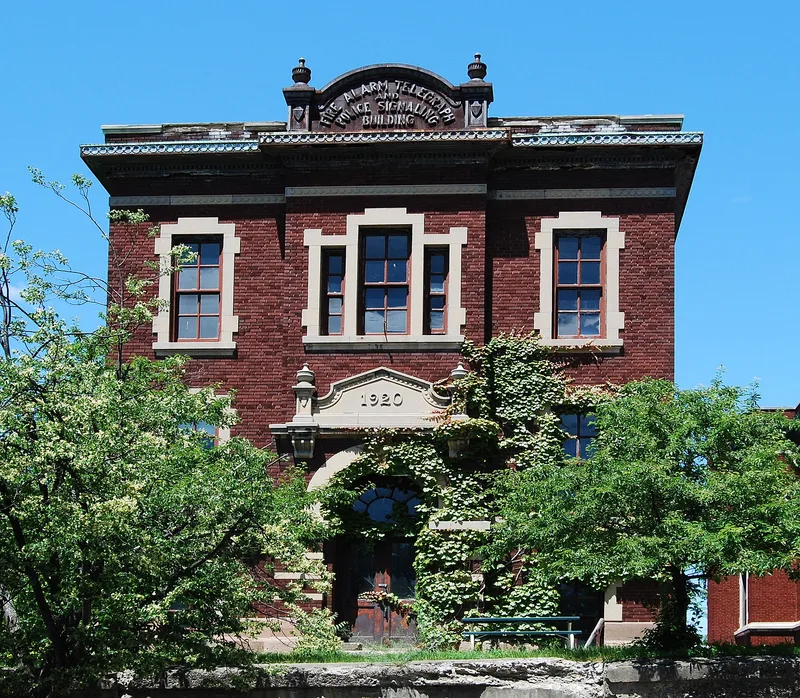
Built in 1920-22 at 67 State Street in Troy, this symmetrical red brick building was the nerve center of the city's fire alarm and police signaling system. Two stories tall on a raised basement, it has a steel frame, fireproof metal windows and cast stone trim in an eclectic mix of classical and Jacobean details. A small brick workshop stands behind it. The building replaced an older practice of ringing church and city bells to report fires. Its system relied on about 80 miles of overhead wire and twelve miles of underground cable linking street boxes to a main switchboard, and it went into service on January 23, 1922, at a cost of $235,000. It stood near a growing group of municipal buildings, including the Public Health Building. As telephones spread, it became redundant and closed in 1968. Since then it has served only for storage. It is recognized for its civic architecture and its role in public safety.
Significance in brief: It is argued to be a good representative example of civic architecture in Rensselaer County, with eclectic classical and Jacobean ornamentation. It is also significant in public safety, marking a turning point from bell-based alarms to a modern wired signaling system in 1922. Its fireproof construction and place in a developing cluster of municipal buildings add to its importance.
Machine-generated summary. This summary was generated by a language model from the official nomination document and has not been reviewed line by line by an editor. It may contain errors. Check the source document before relying on any detail. Source: nomination document (PDF) · National Archives catalog entry. NRHP reference 02001714, listed January 15, 2003. Summary generated October 2026 (model claude-sonnet-5-5, prompt v1.0-2026-10-29, confidence high).
Key facts
| Address | 67 State St., Troy |
|---|---|
| County | Rensselaer County |
| Listed | January 15, 2003 |
| Reference number | 02001714 |
| Resource type | Building |
| Period of significance | 1920-52 |
| Architectural style | Late 19th & 20th Century Revivals: Jacobean Revival |
| Criteria |
|
| Areas of significance | Architecture, Other |
| Level of significance | Local |
| Status (as stated in the nomination) | Closed in 1968 after telephones made it redundant; used only for storage since, with some deterioration from lack of use and all original equipment removed. |
| Acreage | 0.9 |
| Coordinates | 42.72986, -73.68610 (NPS GIS) |
What listing means for this property
For an income-producing building, listing (individually or as a contributing building in a district) is the gateway to the 20% federal rehabilitation tax credit on qualified rehabilitation costs, often stackable with state credits. Work claiming the credit must follow the Secretary of the Interior's Standards and be approved in advance.
Listing does not restrict a private owner acting without federal money or permits; where federal funding or licensing is involved, Section 106 review applies.
Noted as vacant in the nomination. Nomination documents can be decades old; current status may differ. If you are considering buying an empty listed property, read the due-diligence checklist.
General information, not legal or tax advice. Rules change; confirm with your State Historic Preservation Office or a qualified adviser.
Sources and further reading
- National Park Service, National Register of Historic Places database (snapshot May 2026), reference 02001714.
- Nomination form (PDF, National Archives) — catalog entry
- Wikipedia article (used for cross-checking only; text not reproduced here)
- Wikidata Q5451314
- This listing as JSON
Last updated October 2026. Found an error? See the editorial policy for how to report it.