75th Avenue-61st Street Historic District

Why it's listed
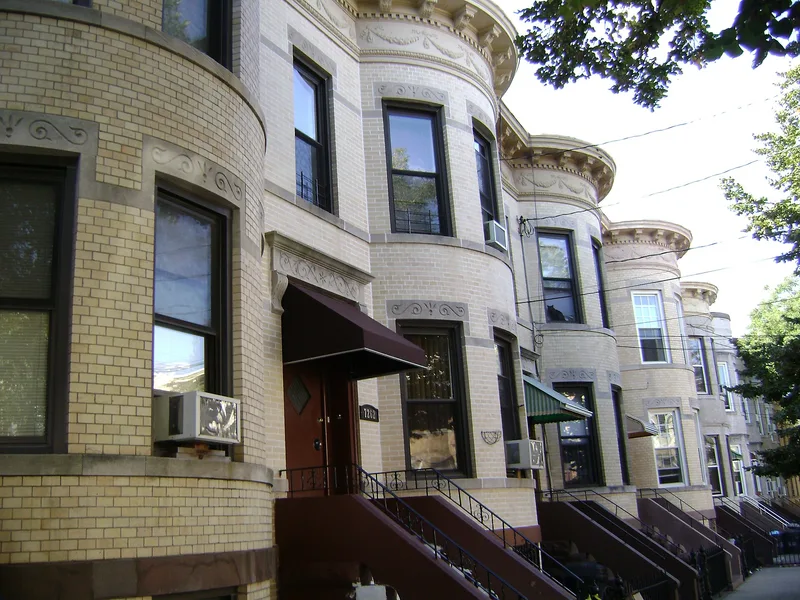
This ten-acre district in Ridgewood, Queens, holds 183 brick buildings erected between 1910 and 1925 along 60th Lane, 61st Street and 62nd Street. Most are two-story row houses with one apartment per floor, set back from the street to allow small front gardens. Rows differ in massing and brick color, with round, box and bay fronts, brownstone stoops, pressed metal cornices and elaborate ironwork. Neo Grec, Renaissance Revival, Romanesque and Classical details appear throughout. The district matters as a cohesive example of working-class housing from Ridgewood's main period of growth, shaped by builders who used consistent setbacks, scale and materials. Its most distinctive row, 75-18 to 75-50 60th Lane, was built from 1920 to 1925 by Charles Fritz to plans by Louis Berger and Co. It shows Arts and Crafts influence, with tiled pent roofs, wide soffits, exaggerated brackets and porches with squat columns, and is the only such row-house group in Ridgewood. Most buildings remain largely unaltered.
Significance in brief: The district is described as an intact, cohesive neighborhood of brick row houses reflecting working-class housing development in Ridgewood. It contains Ridgewood's only Arts and Crafts influenced row houses, at 75-18 to 75-50 60th Lane. Cooperation among builders produced uniform setbacks, scale and materials, with mainly Romanesque and Renaissance Revival ornament.
Machine-generated summary. This summary was generated by a language model from the official nomination document and has not been reviewed line by line by an editor. It may contain errors. Check the source document before relying on any detail. Source: nomination document (PDF) · National Archives catalog entry. NRHP reference 83001764, listed September 30, 1983. Summary generated October 2026 (model claude-sonnet-5-5, prompt v1.0-2026-10-29, confidence medium).
Key facts
| Address | Roughly bounded by St. Felix Ave., 60th Lane, 60th and 62nd Sts., New York |
|---|---|
| County | Queens |
| Listed | September 30, 1983 |
| Reference number | 83001764 |
| Resource type | District |
| Period of significance | 1910-1925 |
| Architect / builder | Charles Fritz (builder) and Louis Berger and Co. (architects) for the 60th Lane Arts and Crafts row, 1920-1925 |
| Architectural style | Arts and Crafts influenced row houses; Romanesque and Renaissance Revival ornament; Neo Grec and Classical Revival detail |
| Areas of significance | Architecture |
| Level of significance | Local |
| Status (as stated in the nomination) | Most buildings remain unaltered; common changes include new doors, stoops, ironwork and awnings. The form lists no non-contributing buildings. |
| Acreage | 10 |
| Coordinates | 40.69928, -73.89423 (NPS GIS) |
What listing means for this property
This is a historic district. Buildings within its boundary are either contributing (they add to the district's significance) or non-contributing. Owners of contributing income-producing buildings can claim the 20% federal rehabilitation tax credit; homeowners should look at state credits. National Register districts impose no design review by themselves; a local historic district ordinance, if one exists, does (the difference explained).
General information, not legal or tax advice. Rules change; confirm with your State Historic Preservation Office or a qualified adviser.
Sources and further reading
- National Park Service, National Register of Historic Places database (snapshot May 2026), reference 83001764.
- Nomination form (PDF, National Archives) — catalog entry
- Wikipedia article (used for cross-checking only; text not reproduced here)
- Wikidata Q4643436
- This listing as JSON
Last updated October 2026. Found an error? See the editorial policy for how to report it.