Putnam County Courthouse

Why it's listed
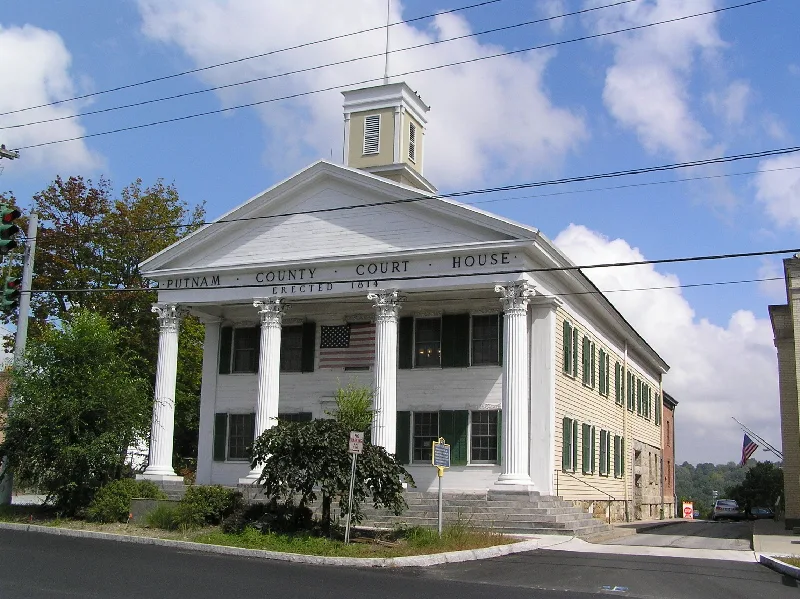
Putnam County Courthouse sits near the center of Carmel village on a rise above Lake Gleneida. The original building went up in 1814, two years after the county government was formed, and local builder and forge owner James Townsend was paid for the work, including ironwork for the jail. Outgrowing the first building by the 1840s, the county considered moving to Cold Spring, but a deed clause kept the courthouse on its site. Around 1847 the structure was expanded and updated into a temple form. A pedimented front with four fluted Corinthian columns, corner pilasters, and a square cupola gives it a Classical Revival appearance. The carved wooden capitals copy those on the Monument of Lysicrates in Athens, a design spread through American builder's guides. The exterior remains largely unchanged from that remodeling, while the interior has been modernized. The building continues to serve as a courthouse and jail.
Significance in brief: It has been the focal point of Putnam County's political and legal activity since 1814 and is described as one of the county's most important historic landmarks. Its c. 1847 giant portico carries carved wooden Corinthian capitals copied from the Monument of Lysicrates in Athens, popularized through nineteenth-century builder's guides. It survives as an important Classical Revival period structure.
Machine-generated summary. This summary was generated by a language model from the official nomination document and has not been reviewed line by line by an editor. It may contain errors. Check the source document before relying on any detail. Source: nomination document (PDF) · National Archives catalog entry. NRHP reference 76001264, listed August 11, 1976. Summary generated October 2026 (model claude-sonnet-5-5, prompt v1.0-2026-10-29, confidence high).
Key facts
| Address | At jct. of NY 52 and NY 301, Carmel |
|---|---|
| County | Putnam County |
| Listed | August 11, 1976 |
| Reference number | 76001264 |
| Resource type | Building |
| Period of significance | 1800-1899 |
| Architect / builder | James Townsend |
| Architectural style | Classical Revival (Greek Revival) |
| Areas of significance | Politics/Government, Architecture |
| Level of significance | Local |
| Status (as stated in the nomination) | Still used as a courthouse and jail; condition marked excellent and altered, with the interior largely subdivided and modernized. |
| Acreage | 0.9 |
| Coordinates | 41.42629, -73.67838 (NPS GIS) |
What listing means for this property
For a publicly owned building or structure, listing mainly matters when federal funds, permits or licences are involved: projects then go through Section 106 review so effects on the property are considered. Listing also strengthens applications for preservation grants and, for leased income-producing uses, can enable the federal rehabilitation tax credit.
General information, not legal or tax advice. Rules change; confirm with your State Historic Preservation Office or a qualified adviser.
Sources and further reading
- National Park Service, National Register of Historic Places database (snapshot May 2026), reference 76001264.
- Nomination form (PDF, National Archives) — catalog entry
- Wikipedia article (used for cross-checking only; text not reproduced here)
- Wikidata Q7262326
- This listing as JSON
Last updated October 2026. Found an error? See the editorial policy for how to report it.