Oneonta Downtown Historic District

Why it's listed
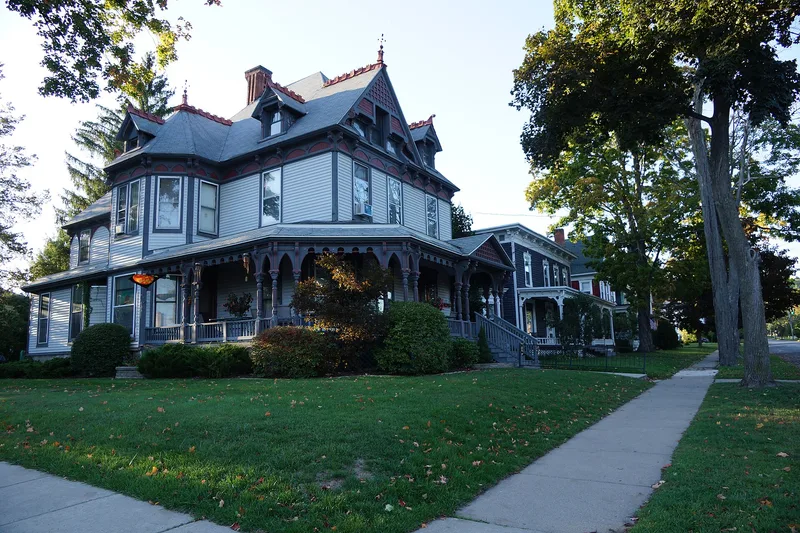
Oneonta's downtown core sits on the north bank of the Susquehanna River in Otsego County, New York. The historic district spans about three blocks of Main Street and adjoining cross streets, along with a row of buildings on Market Street. Most of its buildings are multi-story brick commercial blocks built between about 1870 and 1930. They show shifting tastes, from Greek Revival and Italianate fronts to polychrome brickwork, buff brick with Neoclassical detail, Beaux-Arts civic buildings and Moderne garages. Six churches, a frame Italianate mansion that now serves as the public library, and a five-acre park complete the district. Its importance rests on Oneonta's rise as a railroad hub for the Delaware and Hudson, which carried the population from roughly 700 in 1865 to nearly 10,000 by 1910. Despite urban renewal and some losses, the district remains cohesive and still serves as the city's commercial, civic and religious center.
Significance in brief: The district is presented as a well-preserved example of a central New York small-city business district. It is tied to Oneonta's growth as a regional transportation center and a Delaware and Hudson Railroad hub between 1866 and 1953. Despite urban renewal in the 1960s and 1970s, the historic core stays highly intact and still serves as a center of community activity.
Machine-generated summary. This summary was generated by a language model from the official nomination document and has not been reviewed line by line by an editor. It may contain errors. Check the source document before relying on any detail. Source: nomination document (PDF) · National Archives catalog entry. NRHP reference 03001245, listed December 4, 2003. Summary generated October 2026 (model claude-sonnet-5-5, prompt v1.0-2026-10-29, confidence medium).
Key facts
| Address | Main, Chestnut, Dietz, Market, Elm, Water, Wall, S. Main Sts., Oneonta |
|---|---|
| County | Otsego County |
| Listed | December 4, 2003 |
| Reference number | 03001245 |
| Resource type | District |
| Period of significance | 1866-1953 |
| Architectural style | Various; Greek Revival, Italianate, Beaux-Arts/Neoclassical, Moderne, English Gothic and Victorian High Gothic |
| Areas of significance | Architecture, Transportation, Commerce, Community Planning and Development, Social History |
| Level of significance | Local |
| Status (as stated in the nomination) | Still used for commerce, government (city hall, post office, municipal offices) and religion; eight resources are noncontributing. |
| Acreage | 31 |
| Coordinates | 42.45320, -75.06253 (NPS GIS) |
What listing means for this property
This is a historic district. Buildings within its boundary are either contributing (they add to the district's significance) or non-contributing. Owners of contributing income-producing buildings can claim the 20% federal rehabilitation tax credit; homeowners should look at state credits. National Register districts impose no design review by themselves; a local historic district ordinance, if one exists, does (the difference explained).
General information, not legal or tax advice. Rules change; confirm with your State Historic Preservation Office or a qualified adviser.
Sources and further reading
- National Park Service, National Register of Historic Places database (snapshot May 2026), reference 03001245.
- Nomination form (PDF, National Archives) — catalog entry
- Wikipedia article (used for cross-checking only; text not reproduced here)
- Wikidata Q7093720
- This listing as JSON
Last updated October 2026. Found an error? See the editorial policy for how to report it.