Yelverton Inn and Store

Why it's listed
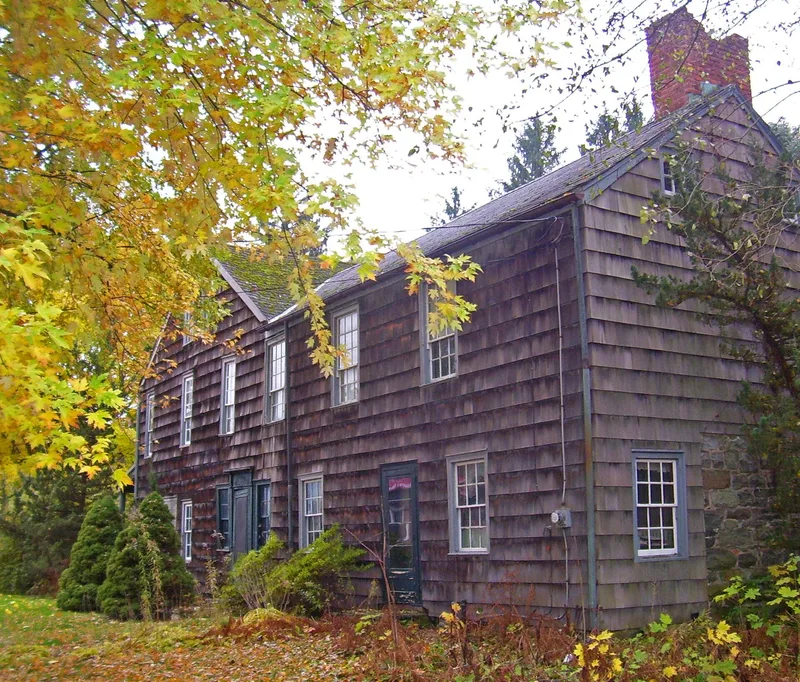
At the corner of Main Street and Academy Avenue in Chester, two buildings recall more than 150 years of commercial and political life in a small crossroads community. The Yelverton Inn, dated to about 1765, is a two-story, L-shaped frame building built in two closely spaced stages. It keeps its original floors, most doors and hardware, and cornice trim, along with two Federal-style doorways attributed to a local craftsman. In 1774 Henry Wisner was chosen at the inn as delegate to the First Continental Congress. In 1785 the barn behind it hosted testimony in a boundary dispute over about 52,000 acres, with attorneys including Aaron Burr and Alexander Hamilton involved. Nearby, Durland's Store, raised in 1841, is a rare surviving Greek Revival commercial building with original shelving and counters. Its enclosed portico could be restored, since its original appearance is known. Both buildings have long been regarded as local landmarks.
Significance in brief: The inn is significant as a substantially intact 18th and 19th century vernacular dwelling and for local historical associations. Henry Wisner was chosen there in 1774 as delegate to the First Continental Congress, and testimony in the 1785 Wawayanda and Cheesecocks patent boundary trial was taken in its barn. Durland's Store is nominated as a rare surviving Greek Revival commercial building.
Machine-generated summary. This summary was generated by a language model from the official nomination document and has not been reviewed line by line by an editor. It may contain errors. Check the source document before relying on any detail. Source: nomination document (PDF) · National Archives catalog entry. NRHP reference 80002733, listed March 28, 1980. Summary generated October 2026 (model claude-sonnet-5-5, prompt v1.0-2026-10-29, confidence medium).
Key facts
| Address | 112-116 Main St., Chester |
|---|---|
| County | Orange County |
| Listed | March 28, 1980 |
| Reference number | 80002733 |
| Resource type | Building |
| Period of significance | 1700-1799 |
| Architect / builder | James Yelverton (Durland's Store, as listed on the form) |
| Architectural style | Vernacular (Yelverton Inn); Greek Revival (Durland's Store) |
| Areas of significance | Commerce, Politics/Government, Architecture |
| Level of significance | Local |
| Status (as stated in the nomination) | Form lists the property as both occupied and unoccupied. The inn is in good condition and altered; the store's first-floor windows are boarded up and its portico is enclosed but appears restorable. The adjacent lot to the south is vacant. |
| Acreage | 1.8 |
| Coordinates | 41.35612, -74.27754 (NPS GIS) |
What listing means for this property
For an income-producing building, listing (individually or as a contributing building in a district) is the gateway to the 20% federal rehabilitation tax credit on qualified rehabilitation costs, often stackable with state credits. Work claiming the credit must follow the Secretary of the Interior's Standards and be approved in advance.
Listing does not restrict a private owner acting without federal money or permits; where federal funding or licensing is involved, Section 106 review applies.
General information, not legal or tax advice. Rules change; confirm with your State Historic Preservation Office or a qualified adviser.
Sources and further reading
- National Park Service, National Register of Historic Places database (snapshot May 2026), reference 80002733.
- Nomination form (PDF, National Archives) — catalog entry
- Wikipedia article (used for cross-checking only; text not reproduced here)
- Wikidata Q8052039
- This listing as JSON
Last updated October 2026. Found an error? See the editorial policy for how to report it.