Fury Brook Farm
Also known as: Bairdlea Farm

Why it's listed
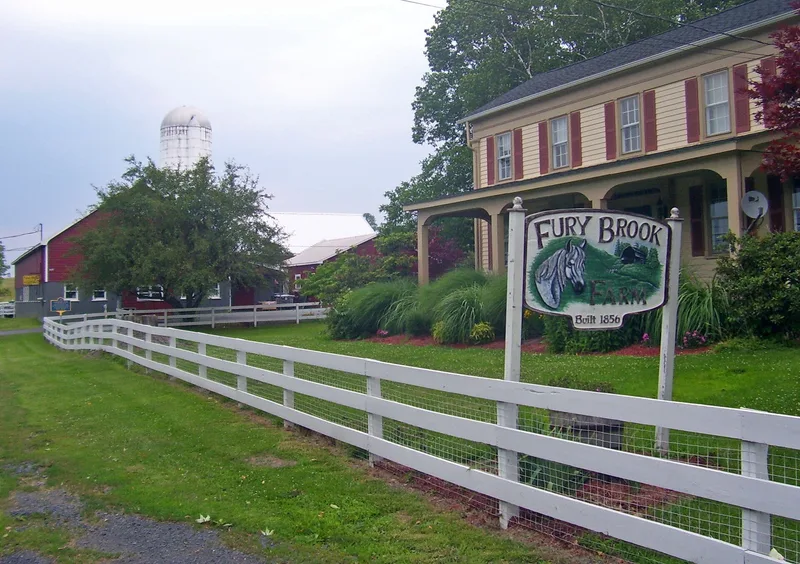
Fury Brook Farm is a compact farm complex of about seven acres on Kings Highway, between the hamlet of Sugar Loaf and the Village of Chester in Orange County, New York. Its land was acquired in 1731 by Nathaniel Roe II, and it passed through the Roe, Rhoads and Baird families. The buildings reflect those periods: a small tenant farmers house from about 1810, a two-story Greek Revival farmhouse dated 1856 by a brownstone tablet, and a large T-shaped dairy barn from 1936 that retains hewn framing from an earlier barn. Other contributing elements include a hay barn, a former milk shed, a stone farm wall and a stone-lined creek. The farm lay along the old Kings Highway, an early transportation route, and grew from subsistence farming into a substantial dairy operation under the Baird family. It is no longer actively farmed, but it records the long course of local agriculture and settlement in the Town of Chester.
Significance in brief: The nomination argues the farm is significant locally for its link to the settlement and growth of the Town of Chester and for showing how local agriculture evolved. Its ownership traces to the 1730s, making it one of the earliest settled parcels in the town. By the early twentieth century it had become one of the town's more substantial dairy operations.
Machine-generated summary. This summary was generated by a language model from the official nomination document and has not been reviewed line by line by an editor. It may contain errors. Check the source document before relying on any detail. Source: nomination document (PDF) · National Archives catalog entry. NRHP reference 04000995, listed September 15, 2004. Summary generated October 2026 (model claude-sonnet-5-5, prompt v1.0-2026-10-29, confidence medium).
Key facts
| Address | Kings Highway, Sugar Loaf |
|---|---|
| County | Orange County |
| Listed | September 15, 2004 |
| Reference number | 04000995 |
| Resource type | Building |
| Period of significance | c. 1810-1954 |
| Architectural style | Mid-19th Century: Greek Revival |
| Criteria |
|
| Areas of significance | Exploration/Settlement, Agriculture, Architecture |
| Level of significance | National, Local |
| Status (as stated in the nomination) | The farm is no longer active in productive agriculture; the main house and tenant house are in residential use and part of the dairy barn houses a machine shop. |
| Acreage | 7 |
| Coordinates | 41.32633, -74.28026 (NPS GIS) |
What listing means for this property
National Register listing is honorary for a privately owned home: it does not by itself restrict what an owner may do with their own money, and it does not require public access. Restrictions come from local landmark or historic-district ordinances, which are separate (how they differ).
Owner-occupied houses are not eligible for the 20% federal rehabilitation tax credit, which applies to income-producing buildings, but many states offer credits for homeowners. Listing also opens the door to preservation easements and to buying a plaque. Start with what listing means for homeowners, renovating a listed house and selling one.
General information, not legal or tax advice. Rules change; confirm with your State Historic Preservation Office or a qualified adviser.
Sources and further reading
- National Park Service, National Register of Historic Places database (snapshot May 2026), reference 04000995.
- Nomination form (PDF, National Archives) — catalog entry
- Wikipedia article (used for cross-checking only; text not reproduced here)
- Wikidata Q5509845
- This listing as JSON
Last updated October 2026. Found an error? See the editorial policy for how to report it.