Sutherland, David, House

Why it's listed
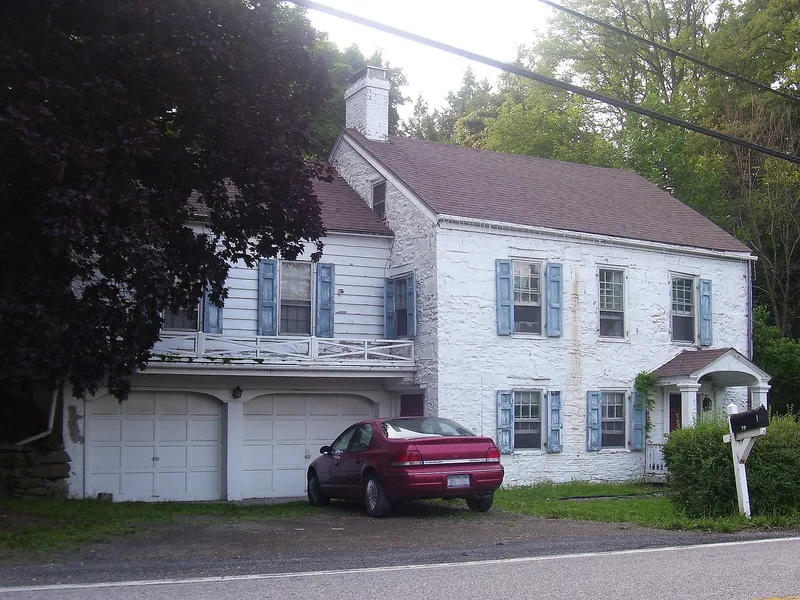
Built around 1770 to 1780 for pioneer farmer David Sutherland, this two-story, three-bay stone farmhouse on Angola Road in Cornwall, New York, is one of the town's few surviving eighteenth-century stone dwellings. The main block is uncoursed fieldstone, with twentieth-century frame additions at the south and rear. Inside, hand-hewn beams with mortise and tenon joints, hand-wrought latches and strap hinges, wideboard floors, original fireplaces and early plaster remain. The Sutherlands were among the first Scots to settle near Moodna Creek in 1685. David's nephew, Captain Patrick Sutherland, a Revolutionary soldier and blacksmith, bought the house and land in 1784, and town meetings were held there in 1798 and from 1800 to 1805. The house may also have served travelers on the old road toward the Monroe mines and New Jersey. Only about three-quarters of an acre of the original farm remains, and modern infill has damaged the surrounding setting, yet the house retains its form, materials and craftsmanship.
Significance in brief: The house is argued to be a rare intact example of an eighteenth-century stone vernacular farmhouse from Cornwall's early settlement period. It is also tied to the Sutherland family, among the town's earliest settlers, including David and his nephew Patrick Sutherland, who bought it in 1784. Town meetings were held there in 1798 and 1800-1805.
Machine-generated summary. This summary was generated by a language model from the official nomination document and has not been reviewed line by line by an editor. It may contain errors. Check the source document before relying on any detail. Source: nomination document (PDF) · National Archives catalog entry. NRHP reference 96000146, listed March 8, 1996. Summary generated October 2026 (model claude-sonnet-5-5, prompt v1.0-2026-10-29, confidence high).
Key facts
| Address | 70 Angola Rd., Cornwall |
|---|---|
| County | Orange County |
| Listed | March 8, 1996 |
| Reference number | 96000146 |
| Resource type | Building |
| Period of significance | ca.1770-ca.1830 |
| Architectural style | Vernacular (Property Type: Vernacular Dwellings, 1685-1830) |
| Criteria |
|
| Areas of significance | Exploration/Settlement, Architecture |
| Level of significance | Local |
| Status (as stated in the nomination) | Still in use as a single-family residence; the original stone house is described as changed very little despite additions. |
| Acreage | 0.9 |
| Coordinates | 41.43065, -74.03875 (NPS GIS) |
What listing means for this property
National Register listing is honorary for a privately owned home: it does not by itself restrict what an owner may do with their own money, and it does not require public access. Restrictions come from local landmark or historic-district ordinances, which are separate (how they differ).
Owner-occupied houses are not eligible for the 20% federal rehabilitation tax credit, which applies to income-producing buildings, but many states offer credits for homeowners. Listing also opens the door to preservation easements and to buying a plaque. Start with what listing means for homeowners, renovating a listed house and selling one.
General information, not legal or tax advice. Rules change; confirm with your State Historic Preservation Office or a qualified adviser.
Sources and further reading
- National Park Service, National Register of Historic Places database (snapshot May 2026), reference 96000146.
- Nomination form (PDF, National Archives) — catalog entry
- Wikipedia article (used for cross-checking only; text not reproduced here)
- Wikidata Q5240188
- This listing as JSON
Last updated October 2026. Found an error? See the editorial policy for how to report it.