Mill House
Also known as: Gomez the Jew House

Why it's listed
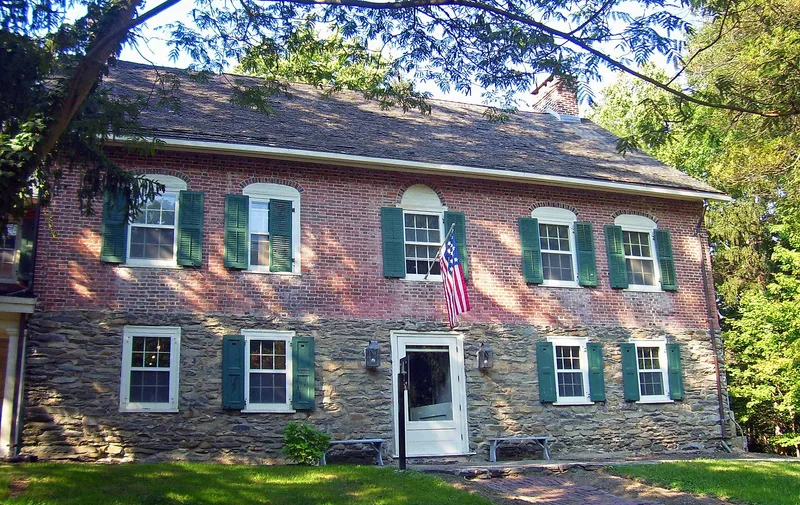
Mill House, on Mill House Road in Newburgh, grew from a fur-trading post built between 1714 and 1720 by Daniel Gomez, son of a Jewish merchant and a member of a leading colonial New York family. The one-story fieldstone building, laid without mortar, had walls two to three feet thick and served as both trading post and fortress, with two large cellars for storing furs. Around 1772 the second owner, Wolfert Acker, added a brick second story and a heart-shaped brick design reflecting his Dutch background. During the Revolution the house was a meeting place for Whigs, and a secret passage ran from the library to the woods. Novelist Henry Armstrong later wrote a Civil War novel there. In 1920 Dard Hunter built a mill beside Jew's Creek to study papermaking. A nineteenth-century kitchen wing, slave quarters and other outbuildings remain on the grounds, and the periods of the house are still easy to read.
Significance in brief: The house began as a fortified fur-trading post built by Daniel Gomez, a member of a prominent colonial New York Jewish family. It later gained a brick second story under Wolfert Acker, served as a Whig meeting place during the Revolution, and was home to novelist Henry Armstrong and papermaker Dard Hunter. Its layers show about 250 years of use with little alteration.
Machine-generated summary. This summary was generated by a language model from the official nomination document and has not been reviewed line by line by an editor. It may contain errors. Check the source document before relying on any detail. Source: nomination document (PDF) · National Archives catalog entry. NRHP reference 73001245, listed January 29, 1973. Summary generated October 2026 (model claude-sonnet-5-5, prompt v1.0-2026-10-29, confidence medium).
Key facts
| Address | Mill House Rd., Newburgh |
|---|---|
| County | Orange County |
| Listed | January 29, 1973 |
| Reference number | 73001245 |
| Resource type | Building |
| Architect / builder | Daniel Gomez (original stone house); Wolfert Acker (second story, c. 1772) |
| Areas of significance | Commerce, Literature, Architecture |
| Level of significance | Local |
| Status (as stated in the nomination) | Listed as in good condition, altered, and occupied as a private residence; recent owners have changed little of the interior or exterior. |
| Acreage | 10 |
| Coordinates | 41.57265, -73.98307 (NPS GIS) |
What listing means for this property
National Register listing is honorary for a privately owned home: it does not by itself restrict what an owner may do with their own money, and it does not require public access. Restrictions come from local landmark or historic-district ordinances, which are separate (how they differ).
Owner-occupied houses are not eligible for the 20% federal rehabilitation tax credit, which applies to income-producing buildings, but many states offer credits for homeowners. Listing also opens the door to preservation easements and to buying a plaque. Start with what listing means for homeowners, renovating a listed house and selling one.
General information, not legal or tax advice. Rules change; confirm with your State Historic Preservation Office or a qualified adviser.
Sources and further reading
- National Park Service, National Register of Historic Places database (snapshot May 2026), reference 73001245.
- Nomination form (PDF, National Archives) — catalog entry
- Wikipedia article (used for cross-checking only; text not reproduced here)
- Wikidata Q5581179
- This listing as JSON
Last updated October 2026. Found an error? See the editorial policy for how to report it.