Collyer, Capt. Moses W., House

Why it's listed
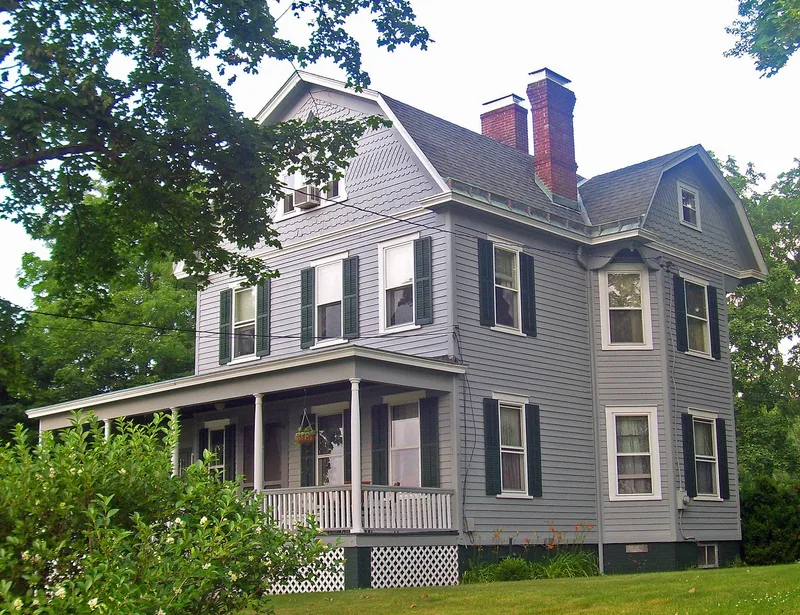
Driftwood is a two-story frame house with a gambrel roof, built in 1899 on a rise above the Hudson River on River Road South in Chelsea, Dutchess County. Captain Moses W. Collyer, who came from a Hudson River maritime family and spent over forty years on boats, had it built near the end of his career, close to the family wharf and boatyard. In 1908 he co-authored The Sloops of the Hudson with William E. Verplanck, a first-hand account of the river's commercial shipping. The house combines Queen Anne massing and varied shingle work with a Palladian window, gambrel roof and porch details drawn from Colonial Revival taste. Inside, an oak stair, marbelized mantels and unpainted woodwork survive. A garden shed, a multi-seat privy and a 1932 garage also contribute. Photographs and receipts from construction survive, documenting building practices of the period. Few changes have been made since 1899.
Significance in brief: The house is significant as the home of Moses W. Collyer, a Hudson River boat captain who co-authored The Sloops of the Hudson (1908). It is also an exceptionally intact example of turn-of-the-century residential architecture, combining Queen Anne massing with Colonial Revival details. A complete record of its construction, including photographs and receipts, adds to its value.
Machine-generated summary. This summary was generated by a language model from the official nomination document and has not been reviewed line by line by an editor. It may contain errors. Check the source document before relying on any detail. Source: nomination document (PDF) · National Archives catalog entry. NRHP reference 87001370, listed August 25, 1987. Summary generated October 2026 (model claude-sonnet-5-5, prompt v1.0-2026-10-29, confidence high).
Key facts
| Address | River Rd. S, Chelsea |
|---|---|
| County | Dutchess County |
| Listed | August 25, 1987 |
| Reference number | 87001370 |
| Resource type | Building |
| Architectural style | Queen Anne combined with Colonial Revival elements |
| Areas of significance | Commerce, Transportation, Architecture, Maritime History |
| Level of significance | Local |
| Status (as stated in the nomination) | Used as a residence, as originally; condition good, with no known threats and few alterations since construction. |
| Acreage | 0.9 |
| Coordinates | 41.55150, -73.97044 (NPS GIS) |
What listing means for this property
National Register listing is honorary for a privately owned home: it does not by itself restrict what an owner may do with their own money, and it does not require public access. Restrictions come from local landmark or historic-district ordinances, which are separate (how they differ).
Owner-occupied houses are not eligible for the 20% federal rehabilitation tax credit, which applies to income-producing buildings, but many states offer credits for homeowners. Listing also opens the door to preservation easements and to buying a plaque. Start with what listing means for homeowners, renovating a listed house and selling one.
General information, not legal or tax advice. Rules change; confirm with your State Historic Preservation Office or a qualified adviser.
Sources and further reading
- National Park Service, National Register of Historic Places database (snapshot May 2026), reference 87001370.
- Nomination form (PDF, National Archives) — catalog entry
- Wikipedia article (used for cross-checking only; text not reproduced here)
- Wikidata Q1035106
- This listing as JSON
Last updated October 2026. Found an error? See the editorial policy for how to report it.