Onondaga Park
Also known as: Upper and Lower Onadaga Park

Why it's listed
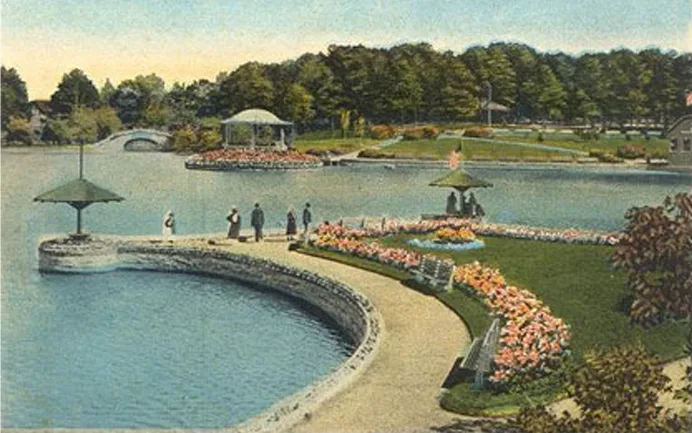
Onondaga Park is an approximately 86-acre city park southwest of downtown Syracuse, opened to the public in July 1898 on a site that began as a reservoir. A steep hillside along Onondaga Avenue splits it into the commonly named upper and lower sections, though the park was treated as a single facility. Its original design followed the naturalistic pleasure ground ideal, with curving drives, rustic stone structures, plantings and planned views. Later changes added recreation features typical of early twentieth century reform parks, including Lake Hiawatha, formed in 1911 from the old reservoir, plus playgrounds, a bathhouse and sports areas. The park contains 47 contributing features, among them buildings, structures, sites and objects such as stone bridges, a pergola and a grotto. It was recognized for retaining two distinct modes of park design and for showing how Syracuse planned large parks on its outskirts to serve a growing population. It remains part of the city's only linked open space system.
Significance in brief: The park is locally significant as an excellent example of park design representing both the Pleasure Ground and Reform Park eras, satisfying Criterion C in landscape architecture. It also meets Criterion A in Community Planning and Development by illustrating patterns of community growth and early city planning, including the trend of creating large parks on the city's edge.
Machine-generated summary. This summary was generated by a language model from the official nomination document and has not been reviewed line by line by an editor. It may contain errors. Check the source document before relying on any detail. Source: nomination document (PDF) · National Archives catalog entry. NRHP reference 02001657, listed December 31, 2002. Summary generated October 2026 (model claude-sonnet-5-5, prompt v1.0-2026-10-29, confidence high).
Key facts
| Address | Roughly bounded by Roberts Ave., Crosett St., Onondaga Ave. and W. Colvin St.;Onondaga and South Ave., and Onondaga St., Syracuse |
|---|---|
| County | Onondaga County |
| Listed | December 31, 2002 |
| Reference number | 02001657 |
| Resource type | District |
| Period of significance | 1881-c. 1938 |
| Architect / builder | George E. Kessler, landscape architect; Webster C. Moulton, architect; Thurber J. Gillette, architect; George A. Helmstetter, park engineer |
| Architectural style | Other: Arts and Crafts; Other: Rustic; Late 19th and 20th Century Revivals: Colonial Revival |
| Criteria |
|
| Areas of significance | Landscape Architecture, Community Planning and Development |
| Level of significance | Local |
| Status (as stated in the nomination) | Still used as a public park for outdoor recreation, sports and music; a firehouse within the park is no longer in use. |
| Acreage | 86 |
| Coordinates | 43.02526, -76.16600 (NPS GIS) |
What listing means for this property
This is a historic district. Buildings within its boundary are either contributing (they add to the district's significance) or non-contributing. Owners of contributing income-producing buildings can claim the 20% federal rehabilitation tax credit; homeowners should look at state credits. National Register districts impose no design review by themselves; a local historic district ordinance, if one exists, does (the difference explained).
General information, not legal or tax advice. Rules change; confirm with your State Historic Preservation Office or a qualified adviser.
Sources and further reading
- National Park Service, National Register of Historic Places database (snapshot May 2026), reference 02001657.
- Nomination form (PDF, National Archives) — catalog entry
- Wikipedia article (used for cross-checking only; text not reproduced here)
- Wikidata Q7094493
- This listing as JSON
Last updated October 2026. Found an error? See the editorial policy for how to report it.