Mills, Harriet May, House

Why it's listed
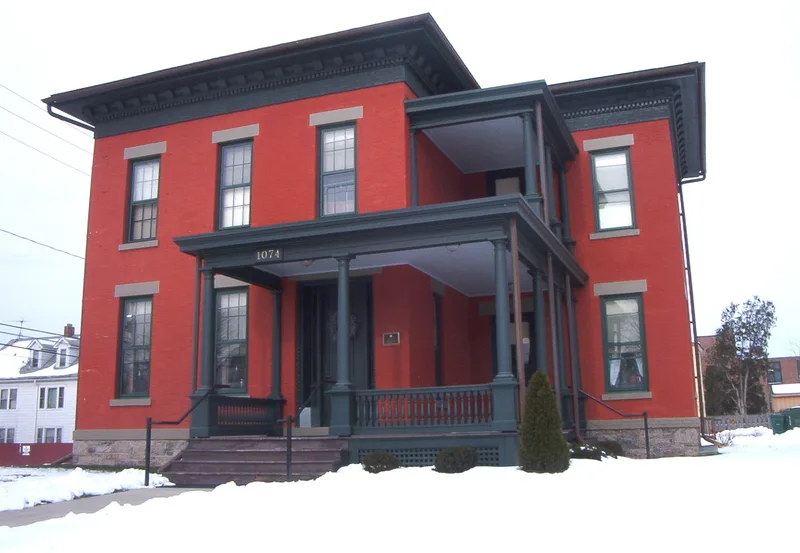
Built in 1858 on a rise at the corner of West Genesee and Liberty Streets in Syracuse, this two-story brick Italianate house was home to the Mills family for nearly ninety years. Charles de Berard Mills, a bookkeeper at the Syracuse Nursery, and his wife Harriet Smith Mills were committed abolitionists who welcomed figures such as Samuel J. May, Gerrit Smith and Ralph Waldo Emerson. Their daughter, Harriet May Mills, born in 1857, became a leading suffragist. She served as president of the New York State suffrage association from 1910, worked with Susan B. Anthony, and in 1920 became the first woman to run for state office for a major party. The state suffrage headquarters was set up in the house in 1900. The house became a hardware store in the 1940s and is now vacant. It lost its porches and had interior changes, but it keeps its brick walls, bracketed eaves and curved entry staircase.
Significance in brief: The house is argued to be significant under Criterion A for its association with abolitionism, woman's rights and the suffrage movement, and under Criterion B for its links to Harriet May Mills, her father Charles de Berard Mills and her mother Harriet Anna Smith Mills. Harriet May Mills was a prominent suffrage leader, president of the New York State suffrage association from 1910, and the first woman to run for state office for a major party. The home hosted leading abolitionists and later served as the state suffrage headquarters.
Machine-generated summary. This summary was generated by a language model from the official nomination document and has not been reviewed line by line by an editor. It may contain errors. Check the source document before relying on any detail. Source: nomination document (PDF) · National Archives catalog entry. NRHP reference 01001495, listed January 24, 2002. Summary generated October 2026 (model claude-sonnet-5-5, prompt v1.0-2026-10-29, confidence high).
Key facts
| Address | 1074 W. Genesee St., Syracuse |
|---|---|
| County | Onondaga County |
| Listed | January 24, 2002 |
| Reference number | 01001495 |
| Resource type | Building |
| Period of significance | 1858 - 1935 |
| Architectural style | Italianate |
| Criteria |
|
| Areas of significance | Social History |
| Level of significance | Local |
| Status (as stated in the nomination) | Converted to a hardware store in the 1940s; currently vacant, with porches removed and interior altered, though it retains a high degree of integrity. |
| Acreage | 0.9 |
| Coordinates | 43.05398, -76.17348 (NPS GIS) |
What listing means for this property
National Register listing is honorary for a privately owned home: it does not by itself restrict what an owner may do with their own money, and it does not require public access. Restrictions come from local landmark or historic-district ordinances, which are separate (how they differ).
Owner-occupied houses are not eligible for the 20% federal rehabilitation tax credit, which applies to income-producing buildings, but many states offer credits for homeowners. Listing also opens the door to preservation easements and to buying a plaque. Start with what listing means for homeowners, renovating a listed house and selling one.
Noted as vacant in the nomination. Nomination documents can be decades old; current status may differ. If you are considering buying an empty listed property, read the due-diligence checklist.
General information, not legal or tax advice. Rules change; confirm with your State Historic Preservation Office or a qualified adviser.
Sources and further reading
- National Park Service, National Register of Historic Places database (snapshot May 2026), reference 01001495.
- Nomination form (PDF, National Archives) — catalog entry
- Wikipedia article (used for cross-checking only; text not reproduced here)
- Wikidata Q14706319
- This listing as JSON
Last updated October 2026. Found an error? See the editorial policy for how to report it.