Lowertown Historic District

Why it's listed
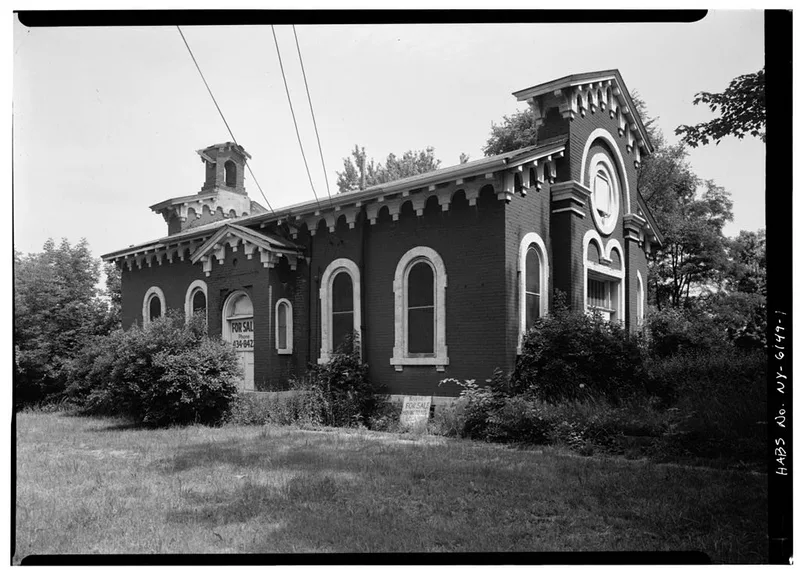
Lowertown is a compact neighborhood in Lockport, New York, set below the Erie Canal locks and bounded by the canal to the north and the Niagara Escarpment and railroad tracks to the south and west. Albany investors laid out its streets soon after the canal opened, hoping to harness water power. Market Street holds the most elegant stone and brick houses, typically two and a half stories with gable roofs and half-elliptical gable windows, while simpler frame cottages fill Garden and Fayette Streets. Notable buildings include the 1829 Lockport Bank, designed by Hezekiah Eldredge, the 1831 home later bought by Governor Washington Hunt, the 1854 Gothic Revival Christ Episcopal Church, the 1864 Vine Street School, and the Western Block Company Warehouse. Lowertown was the city's commercial and industrial center from the 1830s to the 1860s, then lost ground as water power shifted to Upper Town. It has largely avoided heavy traffic and keeps much of its early character.
Significance in brief: Lowertown was Lockport's social, commercial and industrial center from the 1830s to the 1860s and has changed little since. It preserves one of the finest surviving concentrations of early nineteenth century brick and stone architecture in the state. Its buildings include works tied to architect Hezekiah Eldredge and to Governor Washington Hunt.
Machine-generated summary. This summary was generated by a language model from the official nomination document and has not been reviewed line by line by an editor. It may contain errors. Check the source document before relying on any detail. Source: nomination document (PDF) · National Archives catalog entry. NRHP reference 73001225, listed June 4, 1973. Summary generated October 2026 (model claude-sonnet-5-5, prompt v1.0-2026-10-29, confidence medium).
Key facts
| Address | Roughly bounded by Erie Canal and New York Central RR, Lockport |
|---|---|
| County | Niagara County |
| Listed | June 4, 1973 |
| Reference number | 73001225 |
| Resource type | District |
| Period of significance | 1830s-1860s |
| Architect / builder | Hezekiah Eldredge (Lockport Bank Building, 1829) |
| Architectural style | Market Street type houses; Gothic Revival and Italianate details |
| Areas of significance | Industry, Transportation, Architecture |
| Level of significance | Local |
| Status (as stated in the nomination) | Mostly occupied and in use; both sides of Market Street between Adam and Chapel Streets were vacant after 1972 demolitions and slated for urban renewal redevelopment. |
| Acreage | 86 |
| Coordinates | 43.17978, -78.67805 (NPS GIS) |
What listing means for this property
This is a historic district. Buildings within its boundary are either contributing (they add to the district's significance) or non-contributing. Owners of contributing income-producing buildings can claim the 20% federal rehabilitation tax credit; homeowners should look at state credits. National Register districts impose no design review by themselves; a local historic district ordinance, if one exists, does (the difference explained).
General information, not legal or tax advice. Rules change; confirm with your State Historic Preservation Office or a qualified adviser.
Sources and further reading
- National Park Service, National Register of Historic Places database (snapshot May 2026), reference 73001225.
- Nomination form (PDF, National Archives) — catalog entry
- Wikipedia article (used for cross-checking only; text not reproduced here)
- Wikidata Q14706835
- This listing as JSON
Last updated October 2026. Found an error? See the editorial policy for how to report it.