Oyster Bay Long Island Rail Road Station

Why it's listed
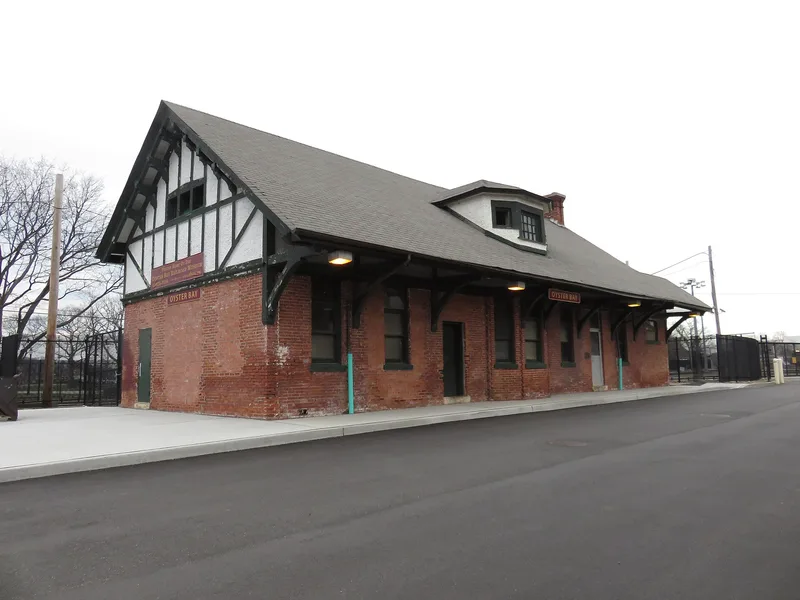
Built in 1902 on Railroad Avenue in Oyster Bay, this Tudor Revival railroad station was designed for the Long Island Rail Road at a time when the village was drawing national attention. President Theodore Roosevelt used the line to reach Sagamore Hill, and the railroad wanted a station worthy of him. The one and one-half story building combines painted brick, half-timbering and stucco, with oyster shells set into the gable stucco as a nod to the community's name and industry. A station master's bay window overlooks the tracks, and decorative timber and sawn brackets support the eaves. Over the years the canopies were largely removed and the interior was subdivided in the 1960s, though original beaded board, timber trusses and gable paneling survive above a suspended ceiling. The station welcomed Roosevelt, visiting dignitaries and many commuters, and it saw the last regular steam locomotive run on the railroad on October 16, 1955. It is now vacant and owned by the Town of Oyster Bay.
Significance in brief: The station is a substantially intact example of turn-of-the-twentieth century railroad station design. It also served as the gateway to Oyster Bay and to Sagamore Hill, the home of President Theodore Roosevelt, and was the scene of the last regular steam locomotive run on the Long Island Rail Road in 1955.
Machine-generated summary. This summary was generated by a language model from the official nomination document and has not been reviewed line by line by an editor. It may contain errors. Check the source document before relying on any detail. Source: nomination document (PDF) · National Archives catalog entry. NRHP reference 05000666, listed July 6, 2005. Summary generated October 2026 (model claude-sonnet-5-5, prompt v1.0-2026-10-29, confidence high).
Key facts
| Address | Railroad Ave., Oyster Bay |
|---|---|
| County | Nassau County |
| Listed | July 6, 2005 |
| Reference number | 05000666 |
| Resource type | Building |
| Period of significance | 1902-1955 |
| Architectural style | Tudor Revival |
| Criteria |
|
| Areas of significance | Architecture, Transportation |
| Level of significance | Local |
| Status (as stated in the nomination) | Most recently used as office space and locker rooms for railroad personnel; a renovation by the Oyster Bay Historical Society is planned and original interior surfaces are being uncovered. Function listed as vacant. |
| Acreage | 0.9 |
| Coordinates | 40.88708, -73.52819 (NPS GIS) |
What listing means for this property
For an income-producing building, listing (individually or as a contributing building in a district) is the gateway to the 20% federal rehabilitation tax credit on qualified rehabilitation costs, often stackable with state credits. Work claiming the credit must follow the Secretary of the Interior's Standards and be approved in advance.
Listing does not restrict a private owner acting without federal money or permits; where federal funding or licensing is involved, Section 106 review applies.
Noted as vacant in the nomination. Nomination documents can be decades old; current status may differ. If you are considering buying an empty listed property, read the due-diligence checklist.
General information, not legal or tax advice. Rules change; confirm with your State Historic Preservation Office or a qualified adviser.
Sources and further reading
- National Park Service, National Register of Historic Places database (snapshot May 2026), reference 05000666.
- Nomination form (PDF, National Archives) — catalog entry
- Wikipedia article (used for cross-checking only; text not reproduced here)
- Wikidata Q7116311
- This listing as JSON
Last updated October 2026. Found an error? See the editorial policy for how to report it.