Spring House

Why it's listed
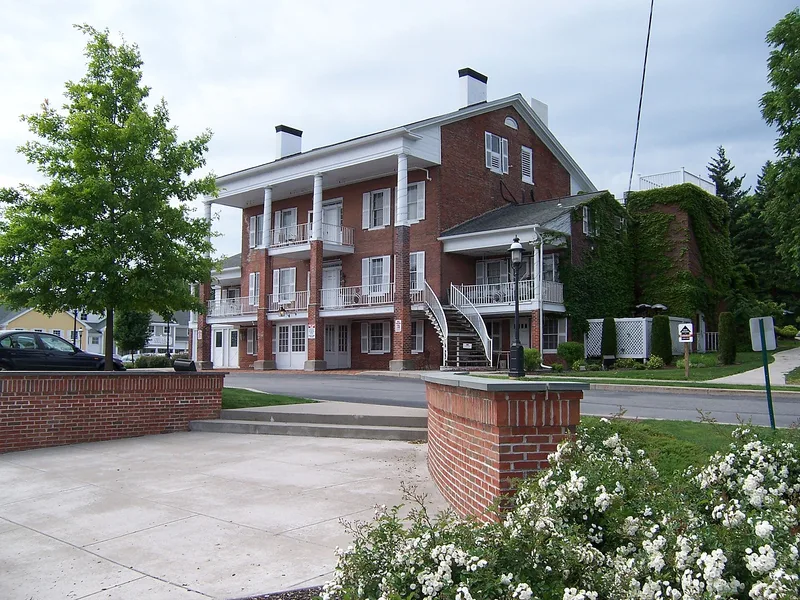
Built in 1832 for Joseph Towsey, this brick inn at 3001 Monroe Avenue in Pittsford sits about five miles east of Rochester, backing onto the old Erie Canal bed. It rises 3 1/2 stories at the front and 2 1/2 at the rear, because it is built into a hillside. A five-bay main block is flanked by two lower wings, and a gabled roof projects to form colonnades on the north and south sides. Centered doorways with leaded transoms and sidelights open on each floor of the front. The second floor keeps its Federal woodwork, mantles, stairway and wainscoting, and the third-floor ballroom is said to have had a spring floor. The inn was placed here because of nearby sulphur springs, discovered in the late 1820s, and the canal that brought visitors. It survives as a small early nineteenth century health resort, an early example of the spring-water spa trade. A dining room was added at the rear in 1961, and the building now operates as a restaurant.
Significance in brief: The nomination presents it as a well-preserved example of a small-scale early nineteenth century health spa, built at Monroe Springs after sulphur springs were discovered in the late 1820s. It represents an early chapter in health care through the medicinal qualities of spring water. Its location was shaped by the springs and the newly completed Erie Canal.
Machine-generated summary. This summary was generated by a language model from the official nomination document and has not been reviewed line by line by an editor. It may contain errors. Check the source document before relying on any detail. Source: nomination document (PDF) · National Archives catalog entry. NRHP reference 75001199, listed November 20, 1975. Summary generated October 2026 (model claude-sonnet-5-5, prompt v1.0-2026-10-29, confidence medium).
Key facts
| Address | 3001 Monroe Ave., Pittsford |
|---|---|
| County | Monroe County |
| Listed | November 20, 1975 |
| Reference number | 75001199 |
| Resource type | Building |
| Period of significance | 1832 |
| Architectural style | Greek Revival |
| Areas of significance | Commerce, Health/Medicine, Architecture |
| Level of significance | Local |
| Status (as stated in the nomination) | Condition listed as excellent and altered; occupied, with a data sheet noting current use as a restaurant/commercial. A dining room addition was made in 1961. |
| Acreage | 2 |
| Coordinates | 43.10914, -77.54617 (NPS GIS) |
What listing means for this property
National Register listing is honorary for a privately owned home: it does not by itself restrict what an owner may do with their own money, and it does not require public access. Restrictions come from local landmark or historic-district ordinances, which are separate (how they differ).
Owner-occupied houses are not eligible for the 20% federal rehabilitation tax credit, which applies to income-producing buildings, but many states offer credits for homeowners. Listing also opens the door to preservation easements and to buying a plaque. Start with what listing means for homeowners, renovating a listed house and selling one.
General information, not legal or tax advice. Rules change; confirm with your State Historic Preservation Office or a qualified adviser.
Sources and further reading
- National Park Service, National Register of Historic Places database (snapshot May 2026), reference 75001199.
- Nomination form (PDF, National Archives) — catalog entry
- Wikipedia article (used for cross-checking only; text not reproduced here)
- Wikidata Q7580604
- This listing as JSON
Last updated October 2026. Found an error? See the editorial policy for how to report it.