Our Mother of Sorrows Roman Catholic Church Complex

Why it's listed
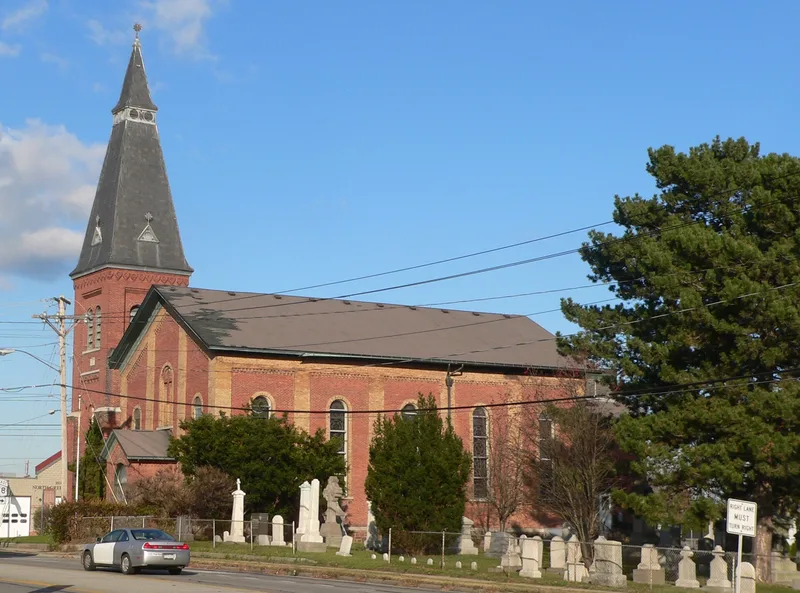
Our Mother of Sorrows church and cemetery occupy a small corner lot at Latta Road and Mount Read Boulevard in Paddy Hill, a former Irish farming community in the town of Greece, near Rochester. The red brick church, begun in 1859 and finished in 1878 when its tower and polychrome slate steeple were completed, uses round-arched openings, buff brick pilasters, corbelled cornices and a marble statue of the Virgin Mary set in a tower niche. Its interior has been converted into a library, though the original stained glass and cornice survive. The adjoining cemetery holds about 460 gravestones, mostly from the 1870s to 1890s, with weeping willow motifs and a granite cross marking the site of the first church. The property was listed for its architecture and funerary art, and for its link to relatively prosperous Irish Catholic settlers who built a self-supporting community centered on the parish. Local tradition credits Andrew Jackson Warner with the design.
Significance in brief: The nomination argues the church is a representative example of Romanesque Revival religious architecture and the cemetery an intact collection of nineteenth and early twentieth century funerary art. It also reflects the history of Paddy Hill's Irish Catholic farming community, an unusually early rural Catholic congregation whose social life centered on the church.
Machine-generated summary. This summary was generated by a language model from the official nomination document and has not been reviewed line by line by an editor. It may contain errors. Check the source document before relying on any detail. Source: nomination document (PDF) · National Archives catalog entry. NRHP reference 89002001, listed November 30, 1989. Summary generated October 2026 (model claude-sonnet-5-5, prompt v1.0-2026-10-29, confidence medium).
Key facts
| Address | 1785 Latta Rd., Greece |
|---|---|
| County | Monroe County |
| Listed | November 30, 1989 |
| Reference number | 89002001 |
| Resource type | Building |
| Period of significance | ca. 1823-ca. 1939 (church: ca. 1859-1878) |
| Architectural style | Romanesque Revival (form classification lists Federal) |
| Criteria |
|
| Areas of significance | European, Architecture |
| Level of significance | Local |
| Status (as stated in the nomination) | The church interior was converted to an open-stack public lending library and heavily altered; the cemetery is in good repair. |
| Acreage | 0.9 |
| Coordinates | 43.25280, -77.65883 (NPS GIS) |
What listing means for this property
Religious properties are listed for their architectural or historical significance, not their religious use. Listing is honorary and does not restrict the congregation's use of the building. The federal rehabilitation credit is generally unavailable unless part of the building is income-producing; some state programmes and preservation grants do cover religious buildings. Federal funding or permits trigger Section 106 review.
General information, not legal or tax advice. Rules change; confirm with your State Historic Preservation Office or a qualified adviser.
Sources and further reading
- National Park Service, National Register of Historic Places database (snapshot May 2026), reference 89002001.
- Nomination form (PDF, National Archives) — catalog entry
- Wikipedia article (used for cross-checking only; text not reproduced here)
- Wikidata Q7111098
- This listing as JSON
Last updated October 2026. Found an error? See the editorial policy for how to report it.