Court Street Bridge

Why it's listed
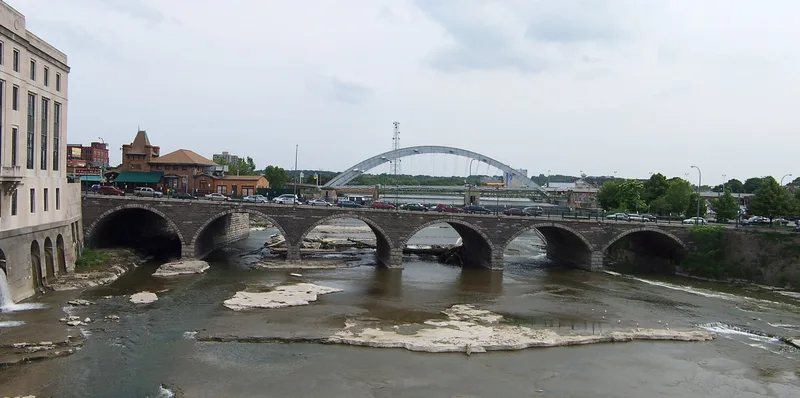
Court Street Bridge carries Court Street across the Genesee River in the heart of Rochester. Completed in 1893 to a design by J.Y. McClintock, a city surveyor and civil engineer, it replaced an earlier bridge of 1858 and cost $150,000. Six segmental arches, each spanning 52 feet, rest on piers six feet thick. Quarry-faced stone, probably sandstone, forms the arches and spandrel facing, with cheaper rubble behind. A 1976 engineering survey called it a transitional form. Later changes include a reinforced concrete roadway in place of paved stone and a new iron handrail. The bridge is one of four historic links between the two sides of the downtown core, along with the Erie Canal Aqueduct and two other stone arch bridges. Together they tied the city's center together and encouraged commercial growth. Built when steel techniques had mostly displaced stone arches, it may deliberately echo the older nearby aqueduct and bridges.
Significance in brief: The bridge is one of four historic crossings linking the two river banks of Rochester's central business district, which drew the city together and supported downtown commercial growth. It is one of two similar round-arch stone bridges built in 1893 at a time when steel construction had largely replaced this method. Its design may have been meant to echo the mid-nineteenth century aqueduct and bridges nearby.
Machine-generated summary. This summary was generated by a language model from the official nomination document and has not been reviewed line by line by an editor. It may contain errors. Check the source document before relying on any detail. Source: nomination document (PDF) · National Archives catalog entry. NRHP reference 84000276, listed October 11, 1984. Summary generated October 2026 (model claude-sonnet-5-5, prompt v1.0-2026-10-29, confidence medium).
Key facts
| Address | Court St. at Genesee River, Rochester |
|---|---|
| County | Monroe County |
| Listed | October 11, 1984 |
| Reference number | 84000276 |
| Resource type | Structure |
| Architect / builder | Architect J.Y. McClintock; builders Lauer & Hagamen, Brayer & Albough |
| Architectural style | Stone arch bridge (described in a 1976 survey as a "transitional form") |
| Areas of significance | Engineering, Transportation |
| Level of significance | Local |
| Status (as stated in the nomination) | Listed in good to excellent condition and still used as a bridge; the original paved stone roadway was replaced with reinforced concrete and the cast-iron handrail with the present iron railing. No threats are known. |
| Acreage | 0.9 |
| Coordinates | 43.15346, -77.60926 (NPS GIS) |
What listing means for this property
For a publicly owned building or structure, listing mainly matters when federal funds, permits or licences are involved: projects then go through Section 106 review so effects on the property are considered. Listing also strengthens applications for preservation grants and, for leased income-producing uses, can enable the federal rehabilitation tax credit.
General information, not legal or tax advice. Rules change; confirm with your State Historic Preservation Office or a qualified adviser.
Sources and further reading
- National Park Service, National Register of Historic Places database (snapshot May 2026), reference 84000276.
- Nomination form (PDF, National Archives) — catalog entry
- Wikipedia article (used for cross-checking only; text not reproduced here)
- Wikidata Q971012
- This listing as JSON
Last updated October 2026. Found an error? See the editorial policy for how to report it.