Substation 13

Why it's listed
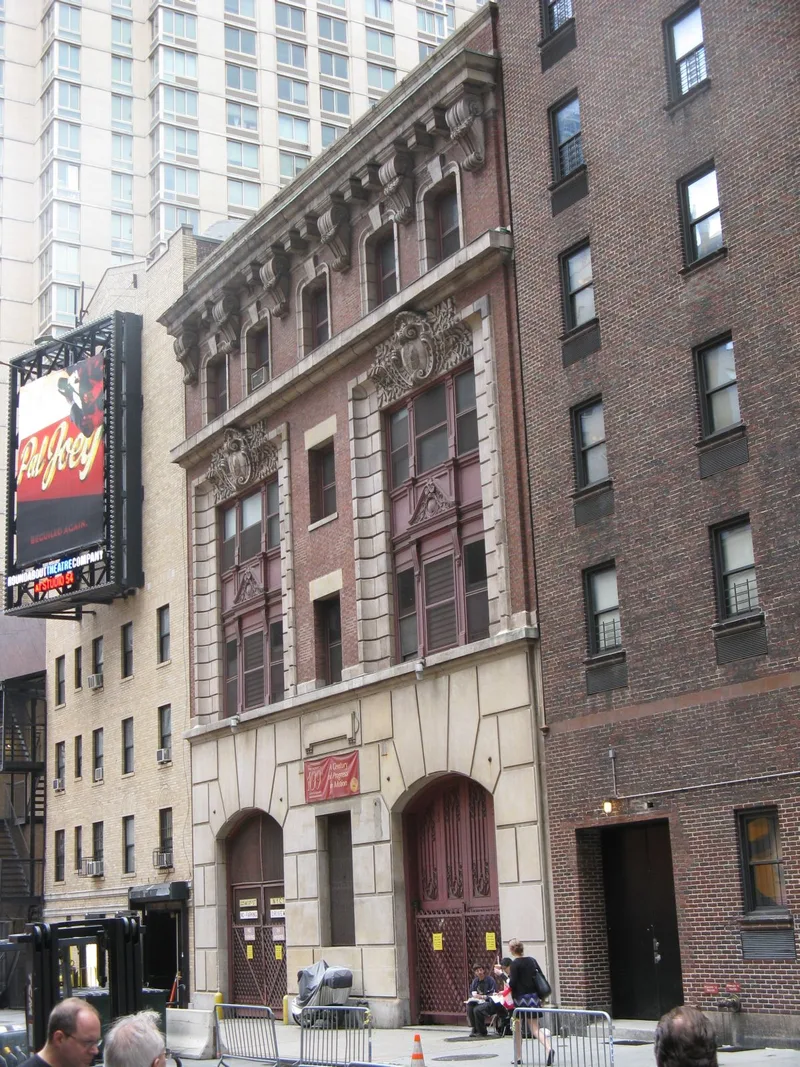
Substation 13, at 225 West 53rd Street in Midtown Manhattan, was built in 1904 to convert alternating current from the IRT powerhouse into direct current for subway trains. Its street front is a Beaux-Arts design with a rusticated limestone base, two arched portals with wrought-iron grilles, terra cotta window frames and a Corinthian cornice, so it resembles a carriage house or fire station more than a power plant. It is one of the most intact early substations in the system. Three original rotary converters, transformers, switch gear, the General Electric control panel and the basement potheads remain, although around 1985 about half the equipment was replaced with modern rectifiers and the central skylight was roofed over. It was built to serve the Broadway/7th Avenue line from 29th to 73rd Street. It was listed for its role in early subway transportation and for its engineering and architectural design. It is still in use and is owned by the transit authority.
Significance in brief: The nomination argues it is significant for transportation, community planning and development (Criterion A), and for engineering and architecture (Criterion C). It is one of the best preserved early IRT substations, with three original rotary converters, transformers, switch gear and a General Electric control panel still in place. Its Beaux-Arts facade disguises its function and remains largely intact.
Machine-generated summary. This summary was generated by a language model from the official nomination document and has not been reviewed line by line by an editor. It may contain errors. Check the source document before relying on any detail. Source: nomination document (PDF) · National Archives catalog entry. NRHP reference 06000026, listed February 9, 2006. Summary generated October 2026 (model claude-sonnet-5-5, prompt v1.0-2026-10-29, confidence high).
Key facts
| Address | 225 W 53rd St., New York |
|---|---|
| County | Manhattan |
| Listed | February 9, 2006 |
| Reference number | 06000026 |
| Resource type | Structure |
| Period of significance | 1904 |
| Architect / builder | Hunter, Paul (Architectural Assistant IRT); Deyo, S. (Chief Engineer IRT Co.) |
| Architectural style | Late 19th Century and Early 20th Century/Beaux-Arts |
| Criteria |
|
| Areas of significance | Transportation, Architecture, Engineering, Community Planning and Development |
| Level of significance | National, Local |
| Status (as stated in the nomination) | Still in use as a substation providing traction power; the interior was altered around 1985, when about half the original equipment was replaced with solid-state rectifiers and the skylight was removed. |
| Acreage | 0.9 |
| Coordinates | 40.76388, -73.98364 (NPS GIS) |
What listing means for this property
National Register listing is honorary: it recognises significance and does not restrict what a private owner may do without federal money or permits. It unlocks the 20% federal rehabilitation tax credit for income-producing buildings, state credits in many states, and Section 106 review when federal agencies are involved. See what listing means in practice.
General information, not legal or tax advice. Rules change; confirm with your State Historic Preservation Office or a qualified adviser.
Sources and further reading
- National Park Service, National Register of Historic Places database (snapshot May 2026), reference 06000026.
- Nomination form (PDF, National Archives) — catalog entry
- Wikidata Q6134968
- This listing as JSON
Last updated October 2026. Found an error? See the editorial policy for how to report it.