Hispanic Society of America Complex

Why it's listed
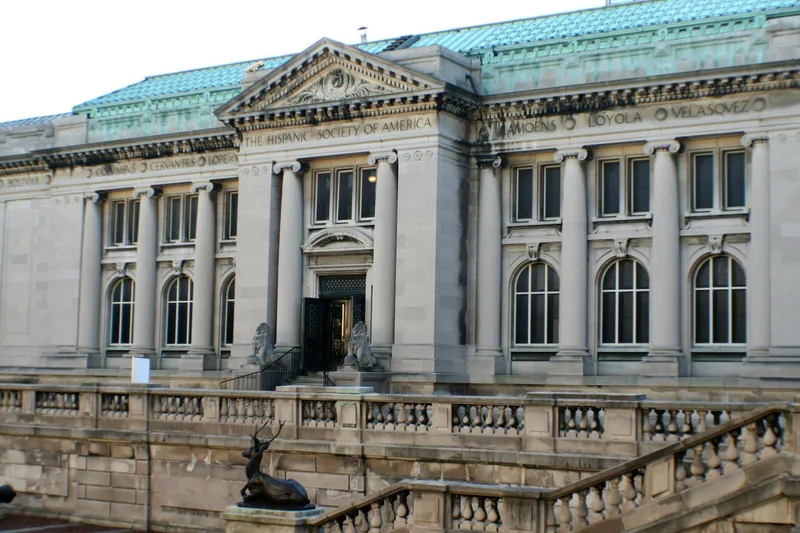
Located on Audubon Terrace in Manhattan's Washington Heights, this museum complex was founded by Archer M. Huntington in 1904 to give Americans direct knowledge of their heritage from Spain. The main building, designed by his cousin Charles P. Huntington and finished in 1908, has an Indiana limestone neoclassical facade, a copper hip roof and a two-story Main Court inspired by Spanish Renaissance architecture. Across the terrace stands the North Building, designed by H. Brooks Price and opened in 1930, with an El Cid sculptural group by Anna Hyatt Huntington in front. A former Museum of the American Indian building, acquired in 2010, is now connected to the complex. The property was designated a National Historic Landmark because it represents a shift in American attitudes toward Hispanic culture and because of its link to Huntington, a major philanthropist who promoted Hispanic studies in the United States.
Significance in brief: The nomination argues the complex is nationally significant under NHL Criterion 1 as an exemplary representation of a shift in American attitudes toward Hispanic culture and Hispanic-American history. Under NHL Criterion 2 it is significant for its association with the philanthropist Archer M. Huntington, who founded the Hispanic Society in 1904. It was also a focal point of Audubon Terrace, a cultural center he established.
Machine-generated summary. This summary was generated by a language model from the official nomination document and has not been reviewed line by line by an editor. It may contain errors. Check the source document before relying on any detail. Source: nomination document (PDF) · National Archives catalog entry. NRHP reference 12001009, listed October 16, 2012. Summary generated October 2026 (model claude-sonnet-5-5, prompt v1.0-2026-10-29, confidence high).
Key facts
| Address | 613 W. 155th St., New York |
|---|---|
| County | Manhattan |
| Listed | October 16, 2012 |
| Reference number | 12001009 |
| Resource type | District |
| Period of significance | 1907-1939 |
| Architect / builder | Charles P. Huntington |
| Architectural style | Late 19th & 20th Century Revivals: Beaux Arts Classicism |
| Criteria |
|
| Level of significance | National |
| National Historic Landmark | Yes, designated October 16, 2012 |
| Status (as stated in the nomination) | Still in use as a museum; the former Museum of the American Indian building was acquired in 2010 and internally connected to the complex. |
| Within district | Audubon Park Historic District |
| Coordinates | 40.83353, -73.94651 (NPS GIS) |
What listing means for this property
This is a historic district. Buildings within its boundary are either contributing (they add to the district's significance) or non-contributing. Owners of contributing income-producing buildings can claim the 20% federal rehabilitation tax credit; homeowners should look at state credits. National Register districts impose no design review by themselves; a local historic district ordinance, if one exists, does (the difference explained).
General information, not legal or tax advice. Rules change; confirm with your State Historic Preservation Office or a qualified adviser.
Sources and further reading
- National Park Service, National Register of Historic Places database (snapshot May 2026), reference 12001009.
- Nomination form (PDF, National Archives) — catalog entry
- Wikipedia article (used for cross-checking only; text not reproduced here)
- Wikidata Q2420849
- This listing as JSON
Last updated October 2026. Found an error? See the editorial policy for how to report it.