Gansevoort Market Historic District

Why it's listed
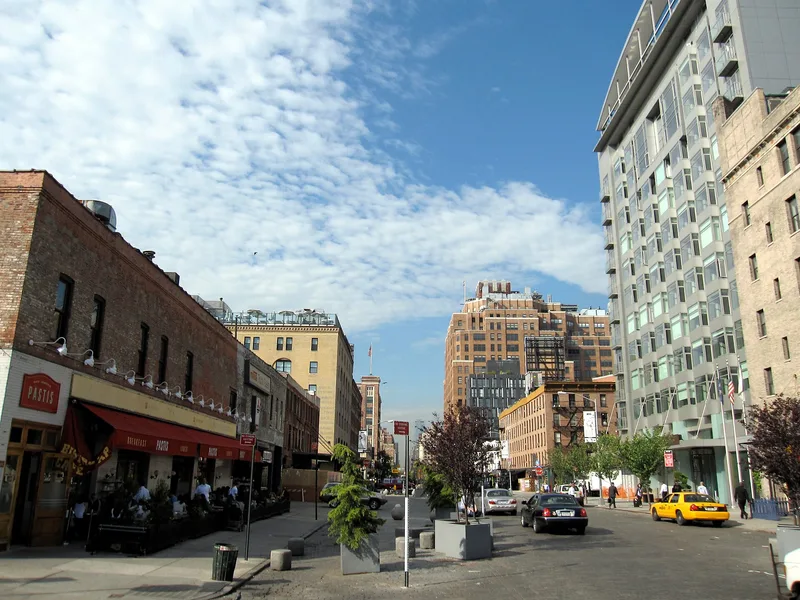
Gansevoort Market Historic District covers all or part of 19 blocks where Greenwich Village meets Chelsea along Manhattan's Hudson River side. It holds 140 contributing buildings, the High Line and the historic street pattern as contributing structures, and a lumber yard as a contributing site. The oldest buildings are three-story Greek Revival rowhouses of the 1840s, along with the 1849 Herring Safe and Lock Factory. Two large municipal markets opened in the 1880s, one for produce and one for meat and poultry, and they drew two- and three-story market buildings with metal canopies, plus warehouses, lofts and cold storage. Large firms followed, including the Manhattan Refrigerating Company and the National Biscuit Company, and architects such as Boring & Tilton designed some of the lofts. Belgian block paving, wide sidewalks and unusual triangular blocks survive. The district was listed for its role in the city's commercial history from about 1840 to 1950, and its character has changed little since.
Significance in brief: The district is argued to represent a significant chapter in New York City's commercial history, when it grew into a major wholesale meat and produce market. Its buildings and street pattern reflect the Hudson River waterfront, railroad and elevated transportation, and the arrival of large firms such as Herring Safe and Lock, DeLamater Iron Works, Nabisco and the Manhattan Refrigerating Company. Several buildings are by prominent architects.
Machine-generated summary. This summary was generated by a language model from the official nomination document and has not been reviewed line by line by an editor. It may contain errors. Check the source document before relying on any detail. Source: nomination document (PDF) · National Archives catalog entry. NRHP reference 07000487, listed May 30, 2007. Summary generated October 2026 (model claude-sonnet-5-5, prompt v1.0-2026-10-29, confidence medium).
Key facts
| Address | Roughly bounded by W 16th St., Ninth Ave., and Hudson St., Gansevoort St.; West St. and Eleventh Ave., New York |
|---|---|
| County | Manhattan |
| Listed | May 30, 2007 |
| Reference number | 07000487 |
| Resource type | District |
| Period of significance | circa 1840-1950 |
| Architect / builder | Boring & Tilton; LaFarge, Morris & Cullen; Boring; Trowbridge & Livingston (among various buildings) |
| Architectural style | Mid-19th Century: Greek Revival; Late Victorian: Italianate, Romanesque, Renaissance; Modern Movement: Moderne, Art Deco |
| Areas of significance | Architecture, Commerce, Industry, Transportation, Community Planning and Development |
| Level of significance | Local |
| Status (as stated in the nomination) | Described as still a busy low-rise commercial district; the current functions list includes vacant/not in use for some buildings. |
| Acreage | 44 |
| Coordinates | 40.74174, -74.00663 (NPS GIS) |
What listing means for this property
This is a historic district. Buildings within its boundary are either contributing (they add to the district's significance) or non-contributing. Owners of contributing income-producing buildings can claim the 20% federal rehabilitation tax credit; homeowners should look at state credits. National Register districts impose no design review by themselves; a local historic district ordinance, if one exists, does (the difference explained).
General information, not legal or tax advice. Rules change; confirm with your State Historic Preservation Office or a qualified adviser.
Sources and further reading
- National Park Service, National Register of Historic Places database (snapshot May 2026), reference 07000487.
- Nomination form (PDF, National Archives) — catalog entry
- Wikidata Q73498076
- This listing as JSON
Last updated October 2026. Found an error? See the editorial policy for how to report it.