Hough, Franklin B., House

Why it's listed
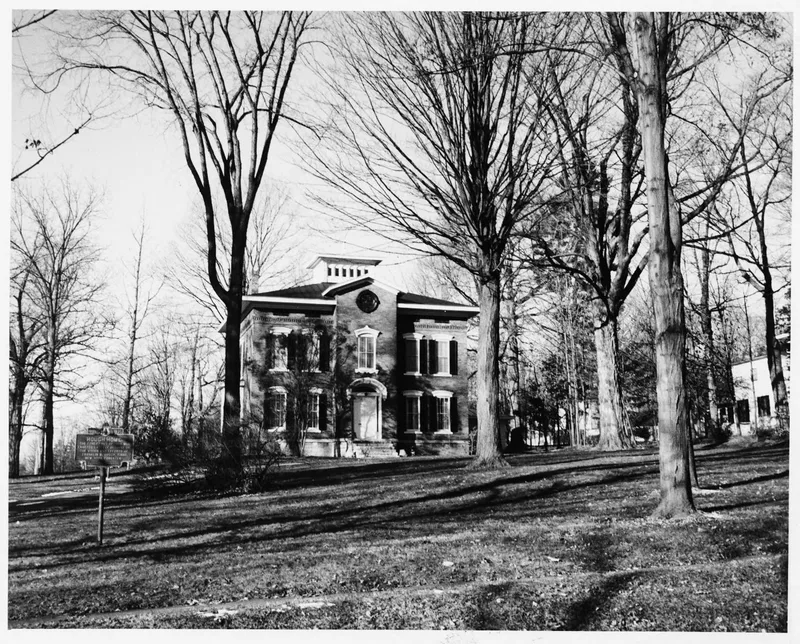
This two-and-a-half story brick house at 29 Collins Street in Lowville, New York, was built in 1860-61 in the style of an Italian villa. It has a projecting central bay with its own gable roof, a hip roof topped by a rectangular belvedere, dentillated cornices and segmental hoodmoulds over the windows. Inside, high ceilings and a spiral staircase in the entrance hall survive largely as they were. A sugar shanty and a chicken coop from the historic period remain on the three-and-a-half-acre lot. The house matters because of Dr. Franklin B. Hough, who lived here from 1863 to 1885. Comparing the New York State censuses of 1855 and 1865, he saw a sharp fall in forest products and began urging the public and Congress to protect the nation's timberlands. In 1876 he became the first federal forest official, and his reports helped shape the later Forest Service. He also wrote the bill creating the Adirondack Forest Preserve in 1885.
Significance in brief: It was the home of Dr. Franklin B. Hough from 1863 to 1885. Hough first recognized the need for a national forest conservation policy and became the first federal forest official in 1876. His work laid the basis for the U.S. Forest Service.
Machine-generated summary. This summary was generated by a language model from the official nomination document and has not been reviewed line by line by an editor. It may contain errors. Check the source document before relying on any detail. Source: nomination document (PDF) · National Archives catalog entry. NRHP reference 66000526, listed October 15, 1966. Summary generated October 2026 (model claude-sonnet-5-5, prompt v1.0-2026-10-29, confidence high).
Key facts
| Address | Collins St., Lowville |
|---|---|
| County | Lewis County |
| Listed | October 15, 1966 |
| Reference number | 66000526 |
| Resource type | Building |
| Period of significance | 1863-85 |
| Architectural style | Italianate (Italian villa style) |
| Areas of significance | Conservation |
| Level of significance | National |
| National Historic Landmark | Yes, designated May 23, 1963 |
| Status (as stated in the nomination) | Still used as a private residence; the interior is basically unchanged since Hough's occupancy, and a bay on the south side was replaced by a glassed-in porch around 1967. |
| Acreage | 3.5 |
| Coordinates | 43.78824, -75.50056 (NPS GIS) |
What listing means for this property
National Register listing is honorary for a privately owned home: it does not by itself restrict what an owner may do with their own money, and it does not require public access. Restrictions come from local landmark or historic-district ordinances, which are separate (how they differ).
Owner-occupied houses are not eligible for the 20% federal rehabilitation tax credit, which applies to income-producing buildings, but many states offer credits for homeowners. Listing also opens the door to preservation easements and to buying a plaque. Start with what listing means for homeowners, renovating a listed house and selling one.
General information, not legal or tax advice. Rules change; confirm with your State Historic Preservation Office or a qualified adviser.
Sources and further reading
- National Park Service, National Register of Historic Places database (snapshot May 2026), reference 66000526.
- Nomination form (PDF, National Archives) — catalog entry
- Wikipedia article (used for cross-checking only; text not reproduced here)
- Wikidata Q14706276
- This listing as JSON
Last updated October 2026. Found an error? See the editorial policy for how to report it.