Leeds Dutch Reformed Church

Why it's listed
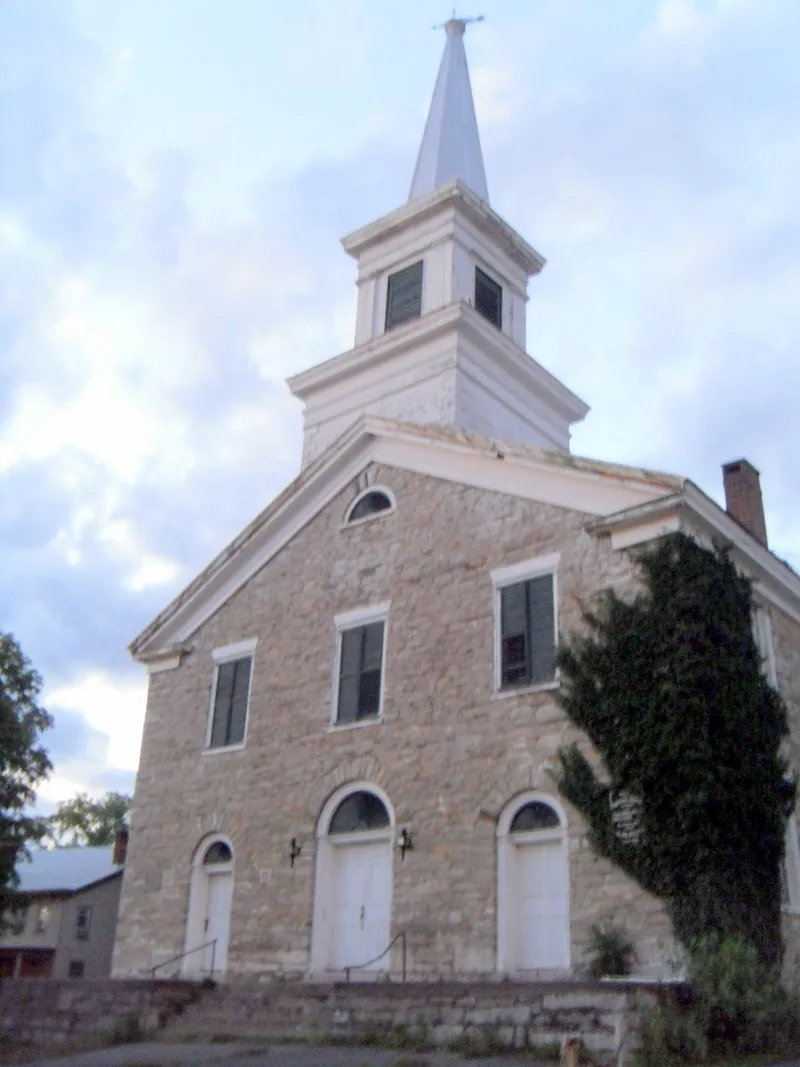
Built of random coursed limestone on a rubblestone foundation, this two-story church sits at the corner of County Route 23B and Church Street in Leeds, Greene County. Its three-bay front has a central pair of six-panel doors under a fanlight, flanked by smaller fanlit entrances, and the windows keep their original twelve-over-twelve sash. A two-stage belfry with an octagonal spire was added about 1855. The congregation decided in 1816 to move into the growing hamlet then called Madison, and the first service was held on July 4, 1818, in the unfinished building. Stone was quarried by local farmers near Green Lake. Inside, the vestibule and auditorium plan survives, along with the original pews, wainscotting and a gallery on iron arches added in a late nineteenth-century remodeling. An 1870 pipe organ is also noted. The nomination describes it as a builder's adaptation of the Federal style, valued for its simplicity and its remarkable integrity.
Significance in brief: The nomination argues the church is an exceptionally intact example of a Federal-era meeting house in Greene County and one of the county's earliest surviving church buildings. It keeps a high degree of exterior and interior integrity. It is also a local landmark tied to the early nineteenth-century settlement of this part of the Hudson Valley.
Machine-generated summary. This summary was generated by a language model from the official nomination document and has not been reviewed line by line by an editor. It may contain errors. Check the source document before relying on any detail. Source: nomination document (PDF) · National Archives catalog entry. NRHP reference 96000141, listed February 22, 1996. Summary generated October 2026 (model claude-sonnet-5-5, prompt v1.0-2026-10-29, confidence high).
Key facts
| Address | Co. Rt. 23B (Susquehanna Tpk.), Leeds |
|---|---|
| County | Greene County |
| Listed | February 22, 1996 |
| Reference number | 96000141 |
| Resource type | Building |
| Period of significance | ca.1818-ca.1890 |
| Architectural style | Early Republic/Federal; Mid-19th Century/Greek Revival |
| Criteria |
|
| Areas of significance | Architecture |
| Level of significance | Local |
| Status (as stated in the nomination) | Still used for religious purposes; the form lists religious use as both historic and current function. |
| Acreage | 0.9 |
| Coordinates | 42.25490, -73.90059 (NPS GIS) |
What listing means for this property
Religious properties are listed for their architectural or historical significance, not their religious use. Listing is honorary and does not restrict the congregation's use of the building. The federal rehabilitation credit is generally unavailable unless part of the building is income-producing; some state programmes and preservation grants do cover religious buildings. Federal funding or permits trigger Section 106 review.
General information, not legal or tax advice. Rules change; confirm with your State Historic Preservation Office or a qualified adviser.
Sources and further reading
- National Park Service, National Register of Historic Places database (snapshot May 2026), reference 96000141.
- Nomination form (PDF, National Archives) — catalog entry
- Wikipedia article (used for cross-checking only; text not reproduced here)
- Wikidata Q6515955
- This listing as JSON
Last updated October 2026. Found an error? See the editorial policy for how to report it.