County and City Hall
Also known as: Old Erie County Hall

Why it's listed
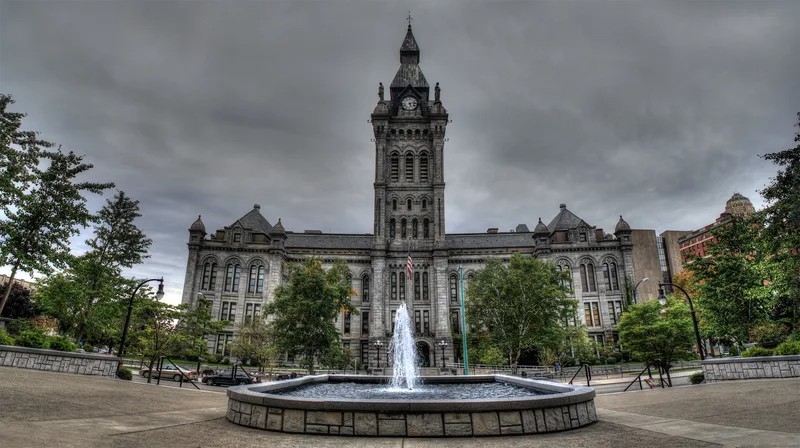
Old Erie County Hall is a massive granite building on a full downtown Buffalo block, bounded by Franklin, Eagle, Delaware and Division streets. Built between 1871 and 1875 to hold offices of both Erie County and the City of Buffalo, it was designed by Rochester architect Andrew Jackson Warner. Its double cruciform plan, rusticated first story, arcaded upper walls and 270-foot clock tower topped by four sixteen-foot granite statues made it a dominant feature of the nineteenth-century skyline. Henry Sala carved the statues. The building opened to the public in March 1876 and served as the seat of both governments for over half a century. Grover Cleveland's career began there as mayor, and President William McKinley's body lay in state in its lobby in 1901. The city moved out in the late 1920s, and the county took full ownership in 1929. It still houses county courts and records beside a 1965 annex. The property is considered Warner's finest civic work.
Significance in brief: The nomination calls it the most significant public building designed by Andrew Jackson Warner and an outstanding example of post-Civil War civic architecture. Its clock tower dominated Buffalo's nineteenth-century skyline, and it remains one of the city's major landmarks. It was also the seat of county and city government for over half a century and the place where President McKinley lay in state in 1901.
Machine-generated summary. This summary was generated by a language model from the official nomination document and has not been reviewed line by line by an editor. It may contain errors. Check the source document before relying on any detail. Source: nomination document (PDF) · National Archives catalog entry. NRHP reference 76001216, listed May 24, 1976. Summary generated October 2026 (model claude-sonnet-5-5, prompt v1.0-2026-10-29, confidence high).
Key facts
| Address | 95 Franklin St., Buffalo |
|---|---|
| County | Erie County |
| Listed | May 24, 1976 |
| Reference number | 76001216 |
| Resource type | Building |
| Period of significance | 1871-1875 |
| Architect / builder | Andrew J. Warner |
| Architectural style | Italian characteristics, reflecting Warner's association with H.H. Richardson; civic architecture of the post-Civil War era |
| Areas of significance | Politics/Government, Architecture |
| Level of significance | Local |
| Status (as stated in the nomination) | Occupied and in good condition; owned by Erie County since 1929 and used for county courts, grand juries and records. Altered over time with minimal effect on its integrity. |
| Acreage | 3 |
| Coordinates | 42.88422, -78.87816 (NPS GIS) |
What listing means for this property
For a publicly owned building or structure, listing mainly matters when federal funds, permits or licences are involved: projects then go through Section 106 review so effects on the property are considered. Listing also strengthens applications for preservation grants and, for leased income-producing uses, can enable the federal rehabilitation tax credit.
General information, not legal or tax advice. Rules change; confirm with your State Historic Preservation Office or a qualified adviser.
Sources and further reading
- National Park Service, National Register of Historic Places database (snapshot May 2026), reference 76001216.
- Nomination form (PDF, National Archives) — catalog entry
- Wikipedia article (used for cross-checking only; text not reproduced here)
- Wikidata Q5177782
- This listing as JSON
Last updated October 2026. Found an error? See the editorial policy for how to report it.