Allentown Historic District
Also known as: See Also: Kleinhans Music Hall

Why it's listed
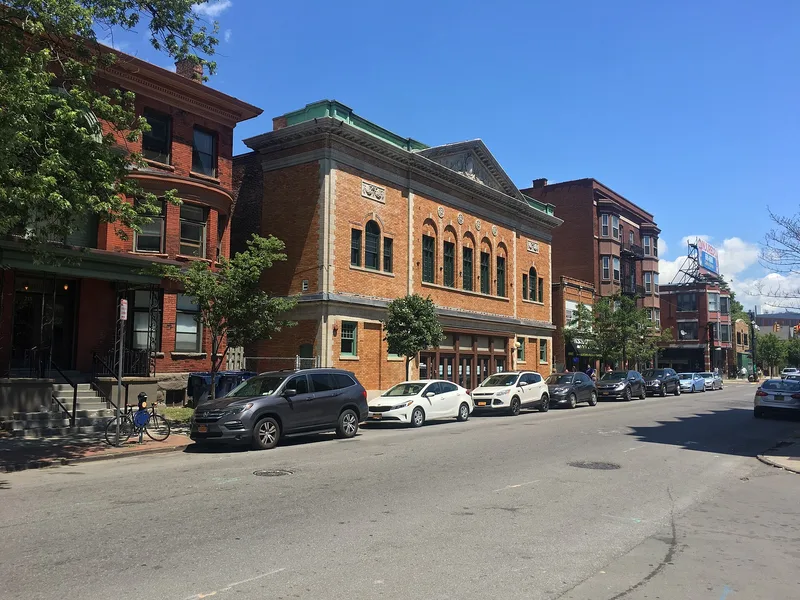
Allentown is a neighborhood of about 733 buildings on 29 blocks, roughly half a mile north of downtown Buffalo. Most are houses built between 1850 and 1900 on former farmland, about three fourths of them frame and the rest brick. The inventory counts Italianate, Queen Anne, Eastlake, Second Empire, Stick, Shingle and Colonial Revival buildings, along with plain frame houses. Commercial buildings from the 1890s line Allen Street and upper Elmwood Avenue, and the district also has residential hotels, three churches, schools and a movie theatre. Frederick Law Olmsted worked on its three parks, including Symphony Circle, the first circle he laid out in Buffalo. The street layout results from the meeting of the Holland Land Company grid and the grid of the village of Black Rock, which produces angular blocks in the west. Streets remain tree-lined with closely spaced two- and three-story houses. Surrounding areas change sharply within a block of the boundaries, which marks Allentown as a distinct section of the city.
Significance in brief: The visible text stresses the district's intact late nineteenth-century architecture and its cohesive character, which sets it apart from the altered or differently built areas around it. It contains a wide range of Victorian styles, three parks worked on by Frederick Law Olmsted, and a street plan formed by two early grid systems. The statement of significance is not included in the excerpt, so the full argument is not shown.
Machine-generated summary. This summary was generated by a language model from the official nomination document and has not been reviewed line by line by an editor. It may contain errors. Check the source document before relying on any detail. Source: nomination document (PDF) · National Archives catalog entry. NRHP reference 80002605, listed April 21, 1980. Summary generated October 2026 (model claude-sonnet-5-5, prompt v1.0-2026-10-29, confidence medium).
Key facts
| Address | Off NY 384, Buffalo |
|---|---|
| County | Erie County |
| Listed | April 21, 1980 |
| Reference number | 80002605 |
| Resource type | District |
| Architect / builder | Frederick Law Olmsted (park designs); Eliel Saarinen (Kleinhans Music Hall); Green and Wicks; Edward Green; George Cary; McKim, Mead & White; Little and Brown, Boston |
| Architectural style | Late nineteenth-century styles including Italianate, Queen Anne, Eastlake, Second Empire, Stick, Shingle, Gothic Revival and Colonial Revival |
| Areas of significance | Industry, Landscape Architecture, Commerce, Entertainment/Recreation, Exploration/Settlement, Architecture, Social History |
| Level of significance | Local |
| Status (as stated in the nomination) | Most buildings are described as well maintained with largely intact architectural features, especially in the east and north sections. Fourteen buildings are identified as intrusions, and the Birge Mansion is listed as vacant. |
| Acreage | 145 |
| Coordinates | 42.89918, -78.87777 (NPS GIS) |
What listing means for this property
This is a historic district. Buildings within its boundary are either contributing (they add to the district's significance) or non-contributing. Owners of contributing income-producing buildings can claim the 20% federal rehabilitation tax credit; homeowners should look at state credits. National Register districts impose no design review by themselves; a local historic district ordinance, if one exists, does (the difference explained).
General information, not legal or tax advice. Rules change; confirm with your State Historic Preservation Office or a qualified adviser.
Sources and further reading
- National Park Service, National Register of Historic Places database (snapshot May 2026), reference 80002605.
- Nomination form (PDF, National Archives) — catalog entry
- Wikipedia article (used for cross-checking only; text not reproduced here)
- Wikidata Q4732064
- This listing as JSON
Last updated October 2026. Found an error? See the editorial policy for how to report it.