Locust Grove
Also known as: Samuel F.B. Morse House
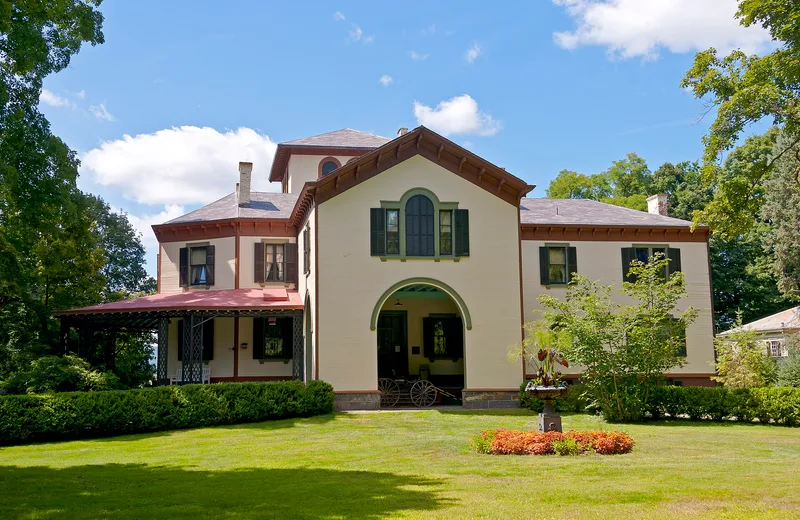

Why it's listed
Locust Grove is a hillside estate in Poughkeepsie, New York, overlooking the Hudson River. A rectangular two-story frame house built in 1830 was bought in 1847 by Samuel F. B. Morse, who used it as the core of a cruciform Italianate villa finished in 1852. Working with architect Alexander Jackson Davis, he added rooms at the north and south ends, an octagonal veranda with cast-iron lattice work, a four-story stuccoed brick tower on the west, and a porte-cochere on the east. The grounds still cover about 108 acres of lawn, pasture and woodland, with locust trees in front of the house. Morse had worked on an electrical telegraph since 1832, received his patent in 1837, and sent the message "What hath God wrought!" in 1844. He returned to the property summer after summer until his death in 1871. The interior is little changed since his time. The property became a house museum in 1975.
Significance in brief: The property is significant as the summer home of Samuel F. B. Morse, credited as the father of the telegraph, who owned it from 1847 until his death in 1871. The interior and house have remained substantially unchanged since his occupancy. The form emphasizes Morse's invention and his long defense of his patent.
Machine-generated summary. This summary was generated by a language model from the official nomination document and has not been reviewed line by line by an editor. It may contain errors. Check the source document before relying on any detail. Source: nomination document (PDF) · National Archives catalog entry. NRHP reference 66000515, listed October 15, 1966. Summary generated October 2026 (model claude-sonnet-5-5, prompt v1.0-2026-10-29, confidence high).
Key facts
| Address | 370 South St., Poughkeepsie |
|---|---|
| County | Dutchess County |
| Listed | October 15, 1966 |
| Reference number | 66000515 |
| Resource type | Building |
| Period of significance | 1847-1871 (Morse's occupancy) |
| Architect / builder | Alexander Jackson Davis, architect (assisted Morse's renovations); John Montgomery built the 1830 frame house |
| Architectural style | Italianate villa (cruciform) |
| Areas of significance | Communications, Invention |
| Level of significance | National |
| National Historic Landmark | Yes, designated January 29, 1964 |
| Status (as stated in the nomination) | Maintained as a private residence until 1975, when it was deeded to the Huguenot Historical Society for use as a historic house museum; the form describes the condition as good and says restoration was underway. |
| Acreage | 108 |
| Coordinates | 41.67273, -73.93499 (NPS GIS) |
What listing means for this property
National Register listing is honorary: it recognises significance and does not restrict what a private owner may do without federal money or permits. It unlocks the 20% federal rehabilitation tax credit for income-producing buildings, state credits in many states, and Section 106 review when federal agencies are involved. See what listing means in practice.
General information, not legal or tax advice. Rules change; confirm with your State Historic Preservation Office or a qualified adviser.
Sources and further reading
- National Park Service, National Register of Historic Places database (snapshot May 2026), reference 66000515.
- Nomination form (PDF, National Archives) — catalog entry
- Wikipedia article (used for cross-checking only; text not reproduced here)
- Wikidata Q6666117
- This listing as JSON
Last updated October 2026. Found an error? See the editorial policy for how to report it.