Bloomvale Historic District
Also known as: Bloom Dale; Bloom's Mills; Bloom Farm

Why it's listed
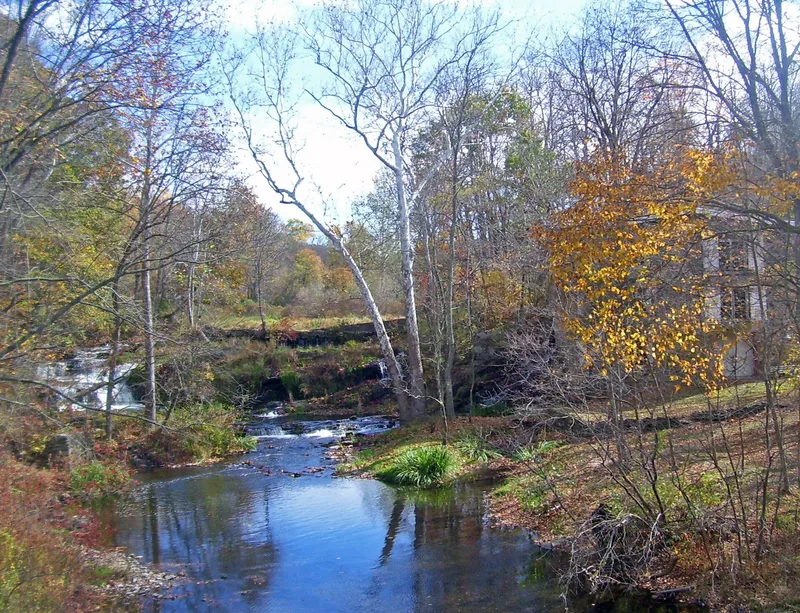
Bloomvale is a former mill site on the East Branch of Wappingers Creek in central Dutchess County, New York, with records reaching back to a 1749 deed. Colonial landholder Henry Filkins' family operated saw and grist mills here. Isaac Bloom later acquired the site and built a Federal-style mansion around 1801, a five-bay frame house with a Palladian window and restrained interior detail. In the 1840s a large stone cotton mill and workers' housing replaced the old grist mill. After the cotton mill burned in 1873, a smaller stone cider mill was built in 1913 from the ruins, with a concrete-reinforced dam and a turbine. The district holds the cider mill, a surviving worker's house, the Bloom house, the water system, old road and bridge abutments, and archeological remains of mill-village buildings. It was listed for the unusually intact survival of an industrial landscape that changed with regional economies, along with its architecture.
Significance in brief: The nomination argues the district is one of Dutchess County's oldest and most intact mill sites, with documented use from the 1740s. It traces a shift from colonial saw and grist mills to a mid-19th-century cotton mill and village, then a 1913 cider mill. The Bloom house is cited as a distinguished example of Federal architecture, and the site holds industrial archeology potential.
Machine-generated summary. This summary was generated by a language model from the official nomination document and has not been reviewed line by line by an editor. It may contain errors. Check the source document before relying on any detail. Source: nomination document (PDF) · National Archives catalog entry. NRHP reference 91001874, listed December 30, 1991. Summary generated October 2026 (model claude-sonnet-5-5, prompt v1.0-2026-10-29, confidence medium).
Key facts
| Address | Jct. of NY 82, Co. Rd. 13 and E. Branch Wappingers Cr., Pleasant Valley and Washington Townships, Salt Point |
|---|---|
| County | Dutchess County |
| Listed | December 30, 1991 |
| Reference number | 91001874 |
| Resource type | District |
| Period of significance | c1740-c1920 |
| Architect / builder | John Rowland (house builder); Edward C. Swezey (mill designer) |
| Architectural style | Early Republic - Federal; No style |
| Criteria |
|
| Areas of significance | Industry, Historic - Non-Aboriginal, Exploration/Settlement, Architecture |
| Level of significance | Local |
| Status (as stated in the nomination) | The 1913 mill has been partly partitioned for use as a residence, and the Bloom house is a private residence. The farm buildings are gone, and the cotton mill survives only as foundations and low walls. |
| Acreage | 38 |
| Coordinates | 41.80115, -73.75492 (NPS GIS) |
What listing means for this property
This is a historic district. Buildings within its boundary are either contributing (they add to the district's significance) or non-contributing. Owners of contributing income-producing buildings can claim the 20% federal rehabilitation tax credit; homeowners should look at state credits. National Register districts impose no design review by themselves; a local historic district ordinance, if one exists, does (the difference explained).
General information, not legal or tax advice. Rules change; confirm with your State Historic Preservation Office or a qualified adviser.
Sources and further reading
- National Park Service, National Register of Historic Places database (snapshot May 2026), reference 91001874.
- Nomination form (PDF, National Archives) — catalog entry
- Wikipedia article (used for cross-checking only; text not reproduced here)
- Wikidata Q4928393
- This listing as JSON
Last updated October 2026. Found an error? See the editorial policy for how to report it.