Cortland County Poor Farm

Why it's listed
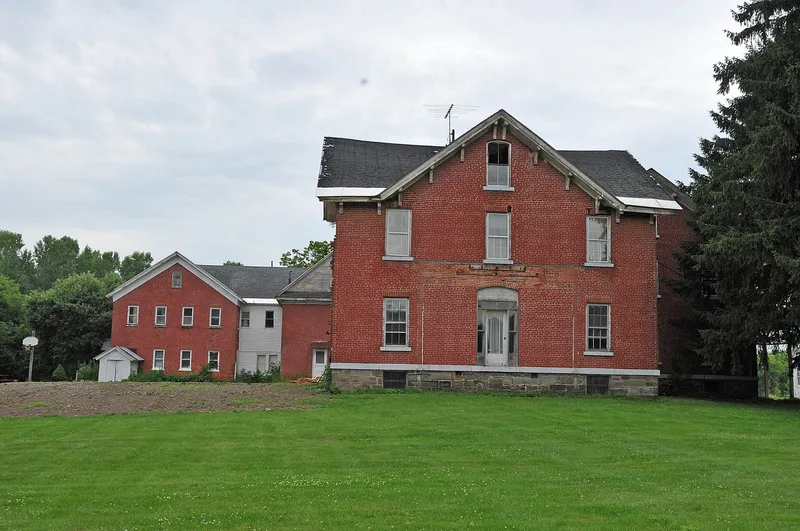
Northeast of Cortland, New York, this county poor farm covers about 112 acres beside the East Branch of the Tioughnioga River. Cortland County bought the land in 1836 from the estate of Judge John Keep, an early settler, after the state authorized a poorhouse. The purchase followed a state program from the 1820s that required counties to maintain farms where paupers could work. By the 1870s overcrowding led to a new brick main building, built around 1873 from plans drawn by local contractor Cyrus Straat, and an asylum was added in 1878 to separate insane inmates. Older Keep-era buildings were moved to the new site and reused, including a chapel or schoolhouse and a cell building. Barns, piggeries and other outbuildings sit to the north and east. Red and white paint, gable roofs and six-over-six windows unify the group. Cortland County still runs it as a working farm supporting welfare programs, which makes it one of the last intact poor farms in New York.
Significance in brief: The farm has served as the site of the county's welfare programs since 1836 and reflects nineteenth-century humanitarian reform and county administration under New York's 1820s county farm program. It is among the last such poor farms in the state still intact and in use. It is also tied to Judge John Keep, an early settler, and its buildings form a distinctive group of vernacular design.
Machine-generated summary. This summary was generated by a language model from the official nomination document and has not been reviewed line by line by an editor. It may contain errors. Check the source document before relying on any detail. Source: nomination document (PDF) · National Archives catalog entry. NRHP reference 82001115, listed October 29, 1982. Summary generated October 2026 (model claude-sonnet-5-5, prompt v1.0-2026-10-29, confidence high).
Key facts
| Address | NE of Cortland off NY 13, Cortland |
|---|---|
| County | Cortland County |
| Listed | October 29, 1982 |
| Reference number | 82001115 |
| Resource type | Building |
| Period of significance | 1800-1899, 1900- (specific dates 1820; 1873) |
| Architect / builder | various; plans for the main building drawn by local contractor Cyrus Straat with the county building committee |
| Architectural style | Utilitarian vernacular |
| Areas of significance | Architecture, Social History, Agriculture |
| Level of significance | Local |
| Status (as stated in the nomination) | Still a working farm owned by Cortland County, in good condition and used to support its welfare programs. |
| Acreage | 111.8 |
| Coordinates | 42.62756, -76.13270 (NPS GIS) |
What listing means for this property
National Register listing is honorary for a privately owned home: it does not by itself restrict what an owner may do with their own money, and it does not require public access. Restrictions come from local landmark or historic-district ordinances, which are separate (how they differ).
Owner-occupied houses are not eligible for the 20% federal rehabilitation tax credit, which applies to income-producing buildings, but many states offer credits for homeowners. Listing also opens the door to preservation easements and to buying a plaque. Start with what listing means for homeowners, renovating a listed house and selling one.
General information, not legal or tax advice. Rules change; confirm with your State Historic Preservation Office or a qualified adviser.
Sources and further reading
- National Park Service, National Register of Historic Places database (snapshot May 2026), reference 82001115.
- Nomination form (PDF, National Archives) — catalog entry
- Wikipedia article (used for cross-checking only; text not reproduced here)
- Wikidata Q5173344
- This listing as JSON
Last updated October 2026. Found an error? See the editorial policy for how to report it.