German Reformed Sanctity Church Parsonage

Why it's listed
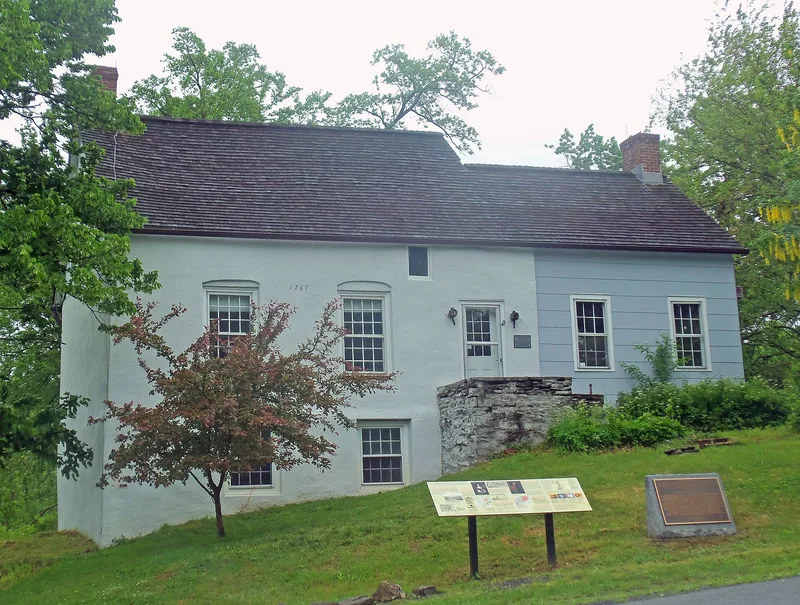
Built on a hillside within sight of the Hudson River in Germantown, this two-part parsonage began around 1746 as the home of the pastor of the German Reformed Sanctity Church of the East Camp. The west section has thick fieldstone walls and a steep slate roof. The east section, believed to date from about 1767, is a brick-filled wood frame. Inside, wide pine floors and some original panelling survive. The house is tied to the Palatine refugees settled at East Camp in 1710 under Governor Robert Hunter, in a plan to produce naval stores for England. When the plan failed, the families who stayed turned to farming. The church owned the parsonage land by 1741 and sold the house in 1805. A restoration in the 1940s repaired the windows, floor joists and chimneys and added modern services. The house is one of the few surviving examples of German vernacular building from this early period and still stands in a rural setting.
Significance in brief: It is one of the few buildings to survive from the early settlement of German (Palatine) immigrants at East Camp, begun in 1710. It is a good example of the vernacular houses built in 18th-century German settlements in New York. It keeps its architectural integrity and its rural setting.
Machine-generated summary. This summary was generated by a language model from the official nomination document and has not been reviewed line by line by an editor. It may contain errors. Check the source document before relying on any detail. Source: nomination document (PDF) · National Archives catalog entry. NRHP reference 76001209, listed January 30, 1976. Summary generated October 2026 (model claude-sonnet-5-5, prompt v1.0-2026-10-29, confidence medium).
Key facts
| Address | Maple Ave., Germantown |
|---|---|
| County | Columbia County |
| Listed | January 30, 1976 |
| Reference number | 76001209 |
| Resource type | Building |
| Architectural style | Vernacular |
| Areas of significance | Architecture |
| Level of significance | Local |
| Status (as stated in the nomination) | Private residence; the form lists it as occupied and in good condition. A major restoration took place in 1944, when the stone walls were stuccoed. |
| Acreage | 1.3 |
| Coordinates | 42.14180, -73.88263 (NPS GIS) |
What listing means for this property
Religious properties are listed for their architectural or historical significance, not their religious use. Listing is honorary and does not restrict the congregation's use of the building. The federal rehabilitation credit is generally unavailable unless part of the building is income-producing; some state programmes and preservation grants do cover religious buildings. Federal funding or permits trigger Section 106 review.
General information, not legal or tax advice. Rules change; confirm with your State Historic Preservation Office or a qualified adviser.
Sources and further reading
- National Park Service, National Register of Historic Places database (snapshot May 2026), reference 76001209.
- Nomination form (PDF, National Archives) — catalog entry
- Wikipedia article (used for cross-checking only; text not reproduced here)
- Wikidata Q14706285
- This listing as JSON
Last updated October 2026. Found an error? See the editorial policy for how to report it.