Brooklyn Borough Hall

Why it's listed
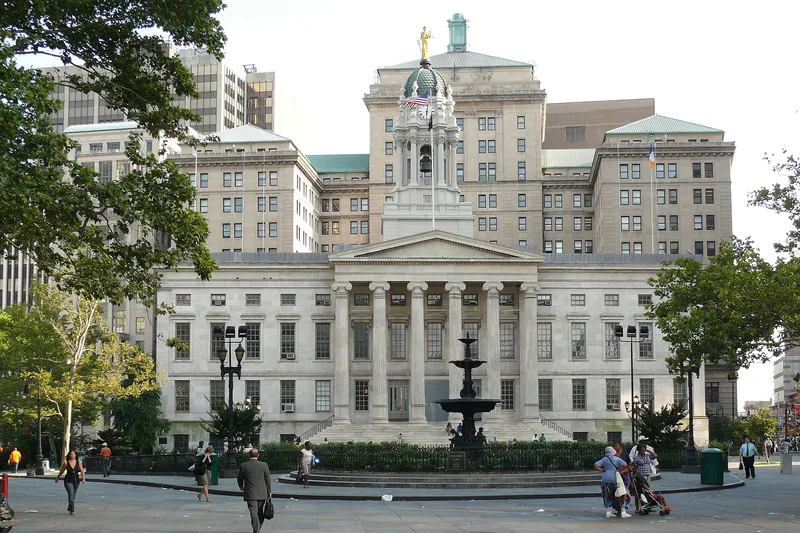
Brooklyn Borough Hall occupies a triangular block at Fulton, Court and Joralemon Streets in downtown Brooklyn. Completed in 1851 to a design by Gamaliel King, a local carpenter, it is a masonry Greek Revival building measuring 175 by 100 feet, with a six-column Ionic portico, pilasters along the sides and a domed clock cupola added in 1897 after a fire destroyed the wooden original. Construction began in the 1830s on a grander plan but halted during the economic depression, and a scaled-down design replaced it. Built as City Hall to hold all municipal departments, the courts and a jail, it became the Borough President's seat after Brooklyn joined New York City in 1898. Interiors were heavily altered, though the original axial plan survives. It is regarded as the oldest public building in Brooklyn and an outstanding example of its style, and it anchors the surrounding civic center.
Significance in brief: The nomination calls it one of New York's finest Greek Revival buildings, notable for its symmetry, temple form with portico, and beautiful proportions. It is the oldest public building in Brooklyn and has housed the borough's seat of government for more than a century. It also expresses the civic pride of the emerging City of Brooklyn.
Machine-generated summary. This summary was generated by a language model from the official nomination document and has not been reviewed line by line by an editor. It may contain errors. Check the source document before relying on any detail. Source: nomination document (PDF) · National Archives catalog entry. NRHP reference 80002630, listed January 10, 1980. Summary generated October 2026 (model claude-sonnet-5-5, prompt v1.0-2026-10-29, confidence high).
Key facts
| Address | 209 Joralemon St., New York |
|---|---|
| County | Brooklyn |
| Listed | January 10, 1980 |
| Reference number | 80002630 |
| Resource type | Building |
| Period of significance | 1800-1899 |
| Architect / builder | Gamaliel King |
| Architectural style | Greek Revival |
| Areas of significance | Law, Politics/Government, Architecture |
| Level of significance | Local |
| Status (as stated in the nomination) | Occupied and in good condition; used for government offices, hearing rooms and courtrooms, with extensive interior alterations after a 1897 fire. |
| Acreage | 1 |
| Coordinates | 40.69286, -73.99028 (NPS GIS) |
What listing means for this property
National Register listing is honorary for a privately owned home: it does not by itself restrict what an owner may do with their own money, and it does not require public access. Restrictions come from local landmark or historic-district ordinances, which are separate (how they differ).
Owner-occupied houses are not eligible for the 20% federal rehabilitation tax credit, which applies to income-producing buildings, but many states offer credits for homeowners. Listing also opens the door to preservation easements and to buying a plaque. Start with what listing means for homeowners, renovating a listed house and selling one.
General information, not legal or tax advice. Rules change; confirm with your State Historic Preservation Office or a qualified adviser.
Sources and further reading
- National Park Service, National Register of Historic Places database (snapshot May 2026), reference 80002630.
- Nomination form (PDF, National Archives) — catalog entry
- Wikipedia article (used for cross-checking only; text not reproduced here)
- Wikidata Q929403
- This listing as JSON
Last updated October 2026. Found an error? See the editorial policy for how to report it.