Willard House and Clock Museum

Why it's listed
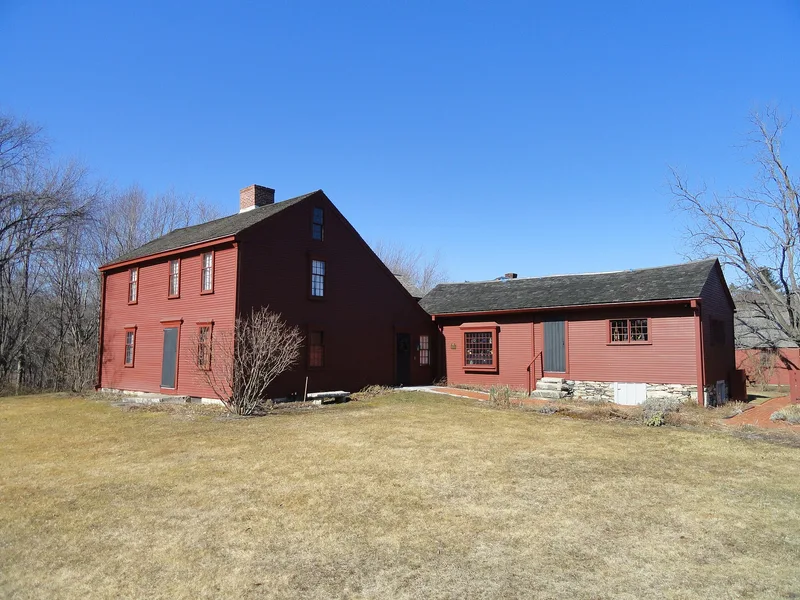
Set on about nine acres of open land in North Grafton, this colonial farmhouse began in 1718 as a single room with a sleeping loft, built by Major Joseph Willard. Around 1760 the west side and second story were added, followed by a lean-to, giving the house its two-and-a-half-story saltbox form. A clock shop built in 1766 stands beside it, along with a barn rebuilt from an 18th-century tavern frame. Four of Benjamin and Sarah Willard's children, Benjamin, Simon, Ephraim and Aaron, were born here and became noted clockmakers. Simon patented a lighthouse clock, and Aaron is credited with the Massachusetts shelf clock. The family's work includes the banjo clock form and the Roxbury tall clock case. The house is the oldest surviving residence in Grafton, and the clock shop is an unusual survivor of small-scale craft production. Restored after its 1968 purchase, it now operates as a museum of Willard clocks.
Significance in brief: The nomination argues the property is significant for its association with four famous Willard clockmakers (Benjamin, Simon, Ephraim and Aaron), all born in the house between 1743 and 1757. It also shows evolving colonial architecture in Grafton and includes a rare surviving 18th-century clock shop. The site may hold archaeological evidence of small-scale crafts production.
Machine-generated summary. This summary was generated by a language model from the official nomination document and has not been reviewed line by line by an editor. It may contain errors. Check the source document before relying on any detail. Source: nomination document (PDF) · National Archives catalog entry. NRHP reference 82004470, listed June 1, 1982. Summary generated October 2026 (model claude-sonnet-5-5, prompt v1.0-2026-10-29, confidence high).
Key facts
| Address | 11 Willard St., Grafton |
|---|---|
| County | Worcester County |
| Listed | June 1, 1982 |
| Reference number | 82004470 |
| Resource type | Building |
| Period of significance | 1700-1799 and 1800-1899 (specific date 1718) |
| Architect / builder | Joseph Willard |
| Architectural style | Colonial period saltbox farmhouse |
| Criteria |
|
| Areas of significance | Industry, Architecture, Invention |
| Level of significance | State |
| Status (as stated in the nomination) | Occupied and in use as a museum; restored 1969-1971, in excellent condition per the form, with a gallery added in 1976. |
| Acreage | 9.5 |
| Coordinates | 42.23891, -71.67311 (NPS GIS) |
What listing means for this property
National Register listing is honorary for a privately owned home: it does not by itself restrict what an owner may do with their own money, and it does not require public access. Restrictions come from local landmark or historic-district ordinances, which are separate (how they differ).
Owner-occupied houses are not eligible for the 20% federal rehabilitation tax credit, which applies to income-producing buildings, but many states offer credits for homeowners. Listing also opens the door to preservation easements and to buying a plaque. Start with what listing means for homeowners, renovating a listed house and selling one.
General information, not legal or tax advice. Rules change; confirm with your State Historic Preservation Office or a qualified adviser.
Sources and further reading
- National Park Service, National Register of Historic Places database (snapshot May 2026), reference 82004470.
- Nomination form (PDF, National Archives) — catalog entry
- Wikipedia article (used for cross-checking only; text not reproduced here)
- Wikidata Q8003427
- This listing as JSON
Last updated October 2026. Found an error? See the editorial policy for how to report it.